Jev Changes Everything
When semantic judgment becomes cheap enough to exist everywhere in software, intelligence stops being the scarce resource. Trustworthy control becomes the scarce resource.
AI is moving from an application feature to an ambient property of software.
Jev is interesting not because it is another model launch, but because it exposes a new computational primitive: cheap, typed, probabilistic judgment that can sit inside ordinary software loops.
For most of the modern AI era, we have treated machine intelligence as something that talks. We ask a question and get words back. We ask for code and get tokens. We give an agent a goal, context, tools, and enough freedom to work toward an answer. That interface has been astonishingly productive, but it has also created an architectural assumption that rarely gets challenged: whenever software needs intelligence, invoke a language model.
Jev challenges that assumption. TypeSafe AI introduced Jev on September 15, 2026 as its first public System One Model. Instead of optimizing for open-ended language generation, Jev evaluates supplied state against bounded questions and returns typed choices, scores, Boolean answers, probabilities, and confidence. TypeSafe describes the model as built for automation, while Vercel describes the interface simply: state goes in, typed decisions come out.
At first glance, this looks like a faster and cheaper way to perform tasks that a general-purpose model can already perform. The more important implication is economic. If semantic judgment becomes inexpensive enough to place at every meaningful boundary, software can move from occasionally consulting AI to continuously evaluating what is happening around it.
This is why the right SharePlane response is not to build around Jev itself. Jev is early, providers will change, and the winning model may be something else entirely. The durable move is to make bounded semantic decisions a first-class primitive of the architecture. SharePlane should own the contract. Models should compete to satisfy it.
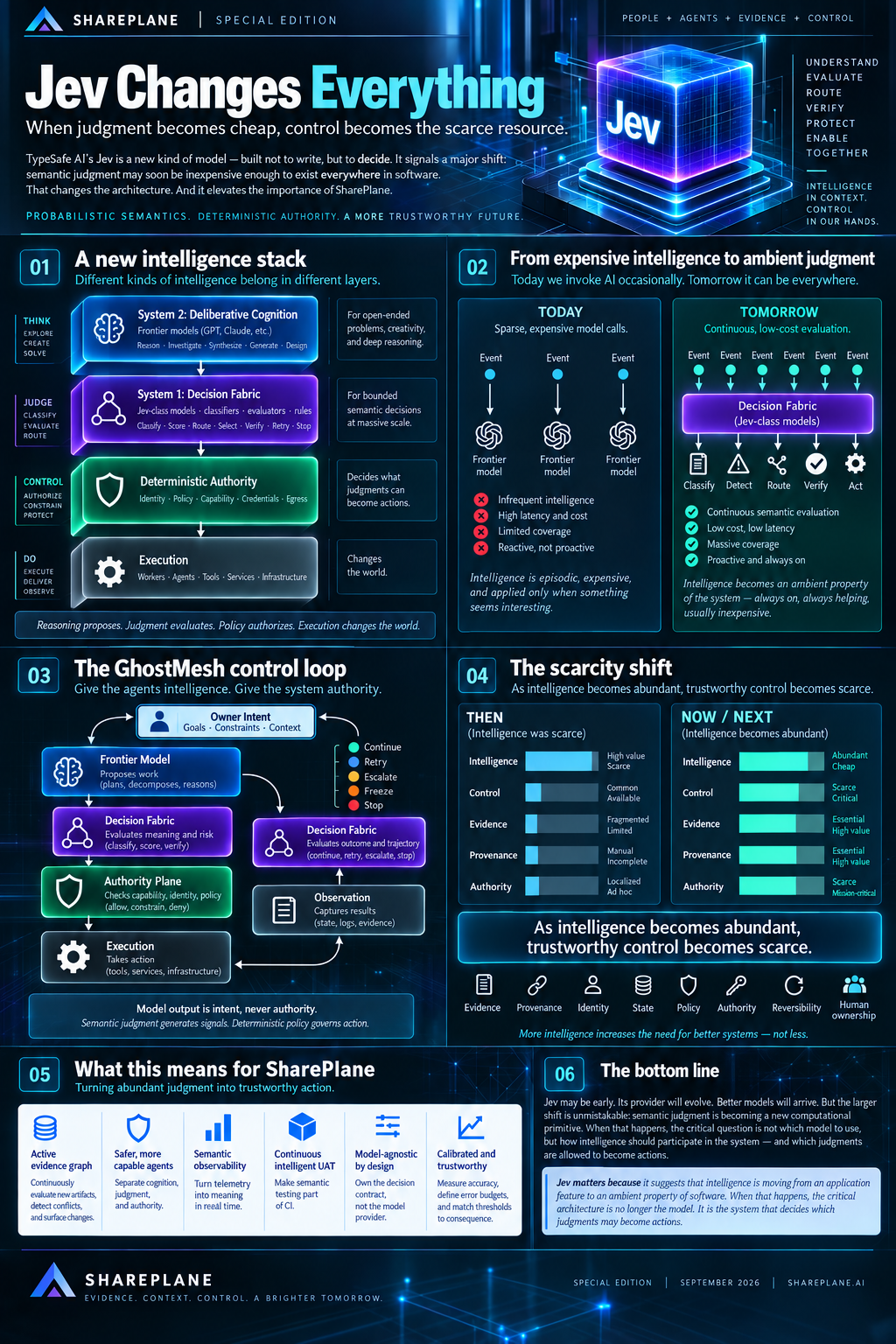
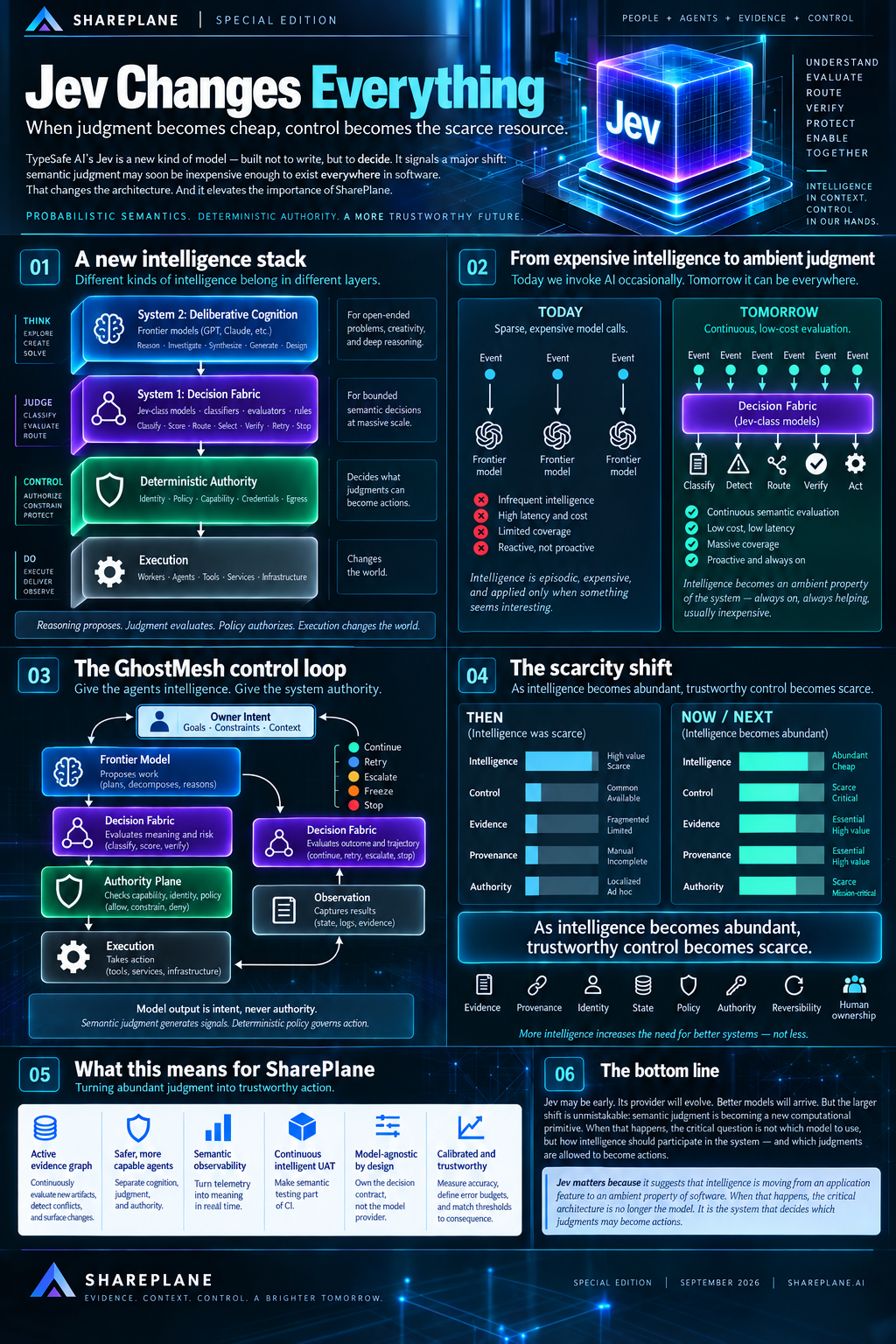
Different kinds of intelligence belong in different layers.
General reasoning, frequent semantic judgment, deterministic authority, and execution solve different problems. Collapsing them into one model call is convenient, but architecturally expensive.
Deliberative Cognition
Frontier models: reason, investigate, synthesize, generate, design, code.
Decision Fabric
Jev-class models, classifiers, evaluators, deterministic checks.
Execution
Workers, agents, tools, services, infrastructure, publication, mutation.
Jev is not a cheaper language model
The easiest mistake is to treat Jev as a substitute for GPT, Claude, or whichever frontier model briefly convinces the industry that history has ended. Frontier models remain valuable because they are general. They can reason through unfamiliar situations, synthesize evidence, write, plan, design, investigate, code, and operate when the shape of the answer is unknown.
Jev gives up that freedom deliberately. Its natural territory is narrower but enormous: Is this relevant? Which route should this take? Does this evidence support the claim? Should this agent continue? Did this action succeed? Does the trajectory look abnormal? Does a human need to review this? These are not primarily writing problems. They are bounded decisions.
Vercel specifically lists next-tool selection, subagent selection, and continue, retry, ask, or stop decisions as Jev use cases. That is a strong clue about where the architecture is heading. The frontier model becomes the expensive thinker. The Decision Fabric becomes the nervous system.
“Zero hallucinations” needs a narrower definition
TypeSafe markets Jev as unable to hallucinate because the model is constrained to declared, typed outputs rather than arbitrary strings. That property is useful. It does not make the semantic judgment automatically true. A model can return a perfectly valid answer and still be wrong.
That distinction tells us where decision models belong in serious systems. They should produce semantic signals with explicit uncertainty. Policy should determine the consequences of those signals. Confidence is not permission, probability is not authority, and type safety is not ground truth.
From episodic intelligence to continuous evaluation.
When judgment becomes cheap, the economic optimum changes. Frontier reasoning can become exception-driven while bounded semantic evaluation runs continuously.
Today
Emerging
continuous semantic evaluation
SharePlane has been evolving around evidence, provenance, identity, state, publication, policy, and controlled action. Until now, semantic intelligence inside that architecture has been comparatively expensive. A frontier model can inspect an artifact, evaluate whether evidence supports a claim, examine an agent trajectory, analyze a publication candidate, or classify an anomaly. Applying that level of reasoning continuously to every artifact and event, however, changes the economics.
Cheap decision models invert that pattern. Every artifact entering SharePlane can receive a semantic fingerprint as part of normal ingestion: what kind of artifact it is, which project it belongs to, whether it appears authoritative, whether it supersedes something older, whether it contains evidence, whether it appears duplicative, and whether a more capable model or a person should inspect it.
The crucial change is frequency. These judgments no longer need to wait for a user to initiate analysis. They can occur continuously as a normal property of the system.
The evidence graph becomes active
Traditional evidence systems largely store things. They retain documents, timestamps, metadata, links, records, and histories, then wait for interpretation. A SharePlane Decision Fabric can continuously evaluate the relationships between evidence and claims instead.
Does a new artifact support an existing claim? Does it contradict it? Is the source independent? Is it newer than the current authority? Does it supersede another record? Has an older piece of evidence become stale because of what just arrived? None of those judgments needs to resolve truth autonomously. They can update semantic state, attach confidence, and surface exceptions.
The system stops behaving like a warehouse and begins behaving like a monitored knowledge environment. Frontier models still investigate difficult conflicts, but they no longer have to discover every conflict themselves. The system notices first.
Give the agents intelligence. Give the system authority.
GhostMesh already has the invariant that matters most: model output is intent, never authority. Decision Fabric strengthens that boundary by making semantic supervision cheap enough to apply continuously.
Most agent systems use the same general-purpose model for serious reasoning and mundane control-loop decisions. The model determines how to solve the problem, decides whether a tool call worked, decides whether to retry, selects another tool, assesses whether enough work has been done, and eventually declares completion. Cognition and orchestration are collapsed because one mechanism happens to be available.
A Decision Fabric separates those responsibilities. The frontier model proposes difficult work. Decision models evaluate intermediate state, select among bounded next actions, check whether expected conditions have been met, and identify divergence from the work order. The deterministic authority layer still decides whether the requested action is allowed.
The deeper benefit is not only lower cost. It is much denser supervision. GhostMesh can evaluate whether an action remains consistent with the work order, whether an agent has expanded scope, whether an egress destination is expected, whether delegation makes sense, whether the trajectory has drifted, or whether a lease should continue. Those evaluations remain signals, not authority.
Observability stops being passive
Traditional observability tells us what happened. Logs capture events, metrics summarize behavior, traces reconstruct execution, and dashboards organize the evidence. Interpretation generally comes later.
When semantic judgment becomes cheap, interpretation can occur while the event stream is still moving. A failed workflow can be evaluated for whether it resembles a transient failure, stale state, an authority mismatch, a dependency problem, or a possible deadlock. An agent completing a task can be evaluated for whether the actual goal appears satisfied rather than merely whether a final process returned exit code zero.
This is particularly important for Tony Brain. A trustworthy State of Affairs should not depend entirely on reconstructing reality after the fact. The system should continuously convert observations into bounded semantic assessments while retaining the underlying evidence. Tony Brain then becomes less of a historian and more of a continuously refreshed operational model.
As intelligence becomes abundant, trustworthy control becomes scarce.
Jev is named after Jevons for a reason. Lowering the cost of intelligence does not necessarily reduce its use. It can multiply the number of places where judgment becomes economically rational.
Then
Intelligence was scarceNow / Next
Intelligence becomes abundantIf a semantic judgment becomes one hundred times cheaper, software designers are unlikely to make the same number of judgments and pocket the savings. They will find hundreds of additional places where judgment is useful. A file arrives, judge it. An agent takes a step, judge it. Evidence changes, judge it. A workflow transitions state, judge it. A security event occurs, judge it.
The number of possible semantic evaluations inside a complex system is enormous. We have been rationing them because semantic intelligence has historically been expensive. If that constraint weakens, the difficult questions move elsewhere.
Which model should be trusted for this decision class? What evidence supported the judgment? What state existed when it was made? Who authorized the resulting action? What policy permitted it? Can the action be reversed? Can another model challenge it? Can a human reconstruct what happened? These are no longer secondary governance questions. They become the architecture.
One poster. One time. The rest of the site does the actual explaining.
This is the polished overview graphic. It remains useful as a shareable summary, but it is no longer doing the work of every visual in the experience.
Promote decision classes, not models.
The right first implementation is deliberately conservative: define the Decision Fabric contract, run Jev in shadow mode, measure it against known outcomes, and promote only the decision classes that earn trust.
Active evidence graph
Continuously evaluate new artifacts, relationships, support, contradiction, freshness, and supersession.
Safer, more capable agents
Separate cognition, semantic judgment, deterministic authority, and execution.
Semantic observability
Turn telemetry into bounded meaning while preserving the raw evidence behind every assessment.
Continuous intelligent UAT
Make semantic testing part of CI, with frontier reasoning reserved for ambiguous failures.
Model-agnostic by design
Own the decision contract and make providers replaceable. Jev is an implementation, not the architecture.
Calibrated and trustworthy
Measure accuracy, false positives, false negatives, calibration, drift, latency, and cost by decision class.
The first five shadow-mode experiments
Start with Control Tower and Tony Brain workflow history, SharePlane publication decisions, Library artifact classification, GhostMesh agent traces, and evidence reconciliation. For each decision, retain the existing outcome, frontier-model judgment where available, Jev result, probability distribution, confidence, latency, cost, and eventual ground truth.
Then measure. Some decision classes will prove suitable for inexpensive continuous evaluation. Some will need specialized models. Some will remain frontier-model territory. Some should remain deterministic forever, and others should always terminate with a human.
The key discipline is to promote decision classes individually rather than declaring a model “trusted.” This keeps experimentation from quietly becoming infrastructure before its failure modes are understood.
Calibration becomes infrastructure
There should never be a universal rule that a decision with ninety percent confidence is safe. Ninety percent may be excellent for routing an article into the correct project. It would be unacceptable for certain high-consequence production actions. Every decision class needs an explicit error budget matched to consequence.
A low-consequence judgment with strong confidence might automate immediately. A moderate-confidence result may trigger additional evidence collection. A high-consequence decision may require deterministic verification regardless of model confidence. An ambiguous case may invoke frontier reasoning, and persistent uncertainty may reach a human.
This is how probability becomes operational rather than decorative.
SharePlane is not an AI application.
Its deeper role is to govern the relationship between intelligence and action.
SharePlane connects what a machine believes to the evidence supporting that belief. It connects evidence to current state, state to policy, policy to authority, authority to execution, and execution back to observation. It preserves provenance across the chain.
That function becomes more important as intelligence becomes cheaper. Better models do not eliminate the need for architecture around them. They increase it. The more judgments software can make, the more carefully we need to determine which judgments are allowed to alter reality.
For the first era of modern AI, intelligence was mostly a destination. A user opened a chatbot, called an API, invoked an assistant, or started an agent. The emerging model is different. Intelligence becomes an ambient property of the software environment, sitting beside storage, networking, logging, authorization, and execution. Every subsystem can cheaply ask bounded semantic questions about what is happening around it.
The most consequential architectural question therefore stops being “Which model should we use?” The better question becomes “How should intelligence participate in the system?” Reasoning, judging, authorizing, and acting are different responsibilities. Confusing them creates fragile systems. Separating them creates infrastructure.
SharePlane is the control plane that turns abundant probabilistic intelligence into governed, evidence-backed, deterministic action.
Source the thesis. Distrust the hype.
The architectural conclusions are ours. Product claims below are linked to current first-party or platform documentation as of September 20, 2026.