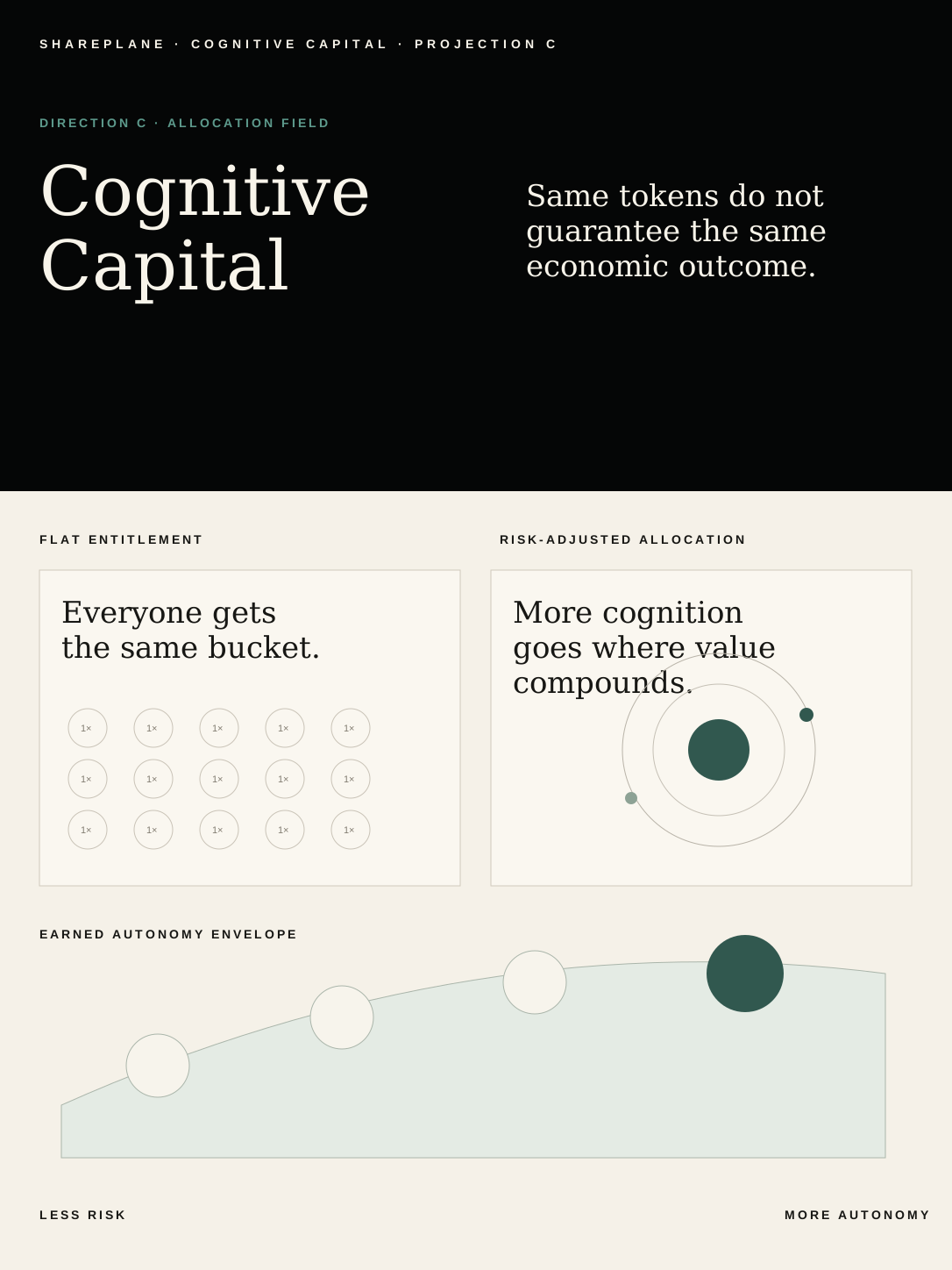
Once cognition produces unequal returns, the enterprise has a capital-allocation problem. The answer is neither flat entitlement nor an unaccountable elite. It is governed, risk-adjusted allocation with an explicit exploration reserve.
The office-software allocation fallacy.
Equal licensing feels fair because traditional software is mostly passive. Agentic cognition is an active capability. Its value, risk, and required governance vary by task and operator.
The allocation unit is not always a person.
Cognition may be allocated to a person, team, product, experiment, workstream, or agentic system. The correct unit is the bounded work unit whose expected value, uncertainty, risk, and evidence can actually be evaluated.
Expected marginal return is necessary but insufficient.
The portfolio also has to account for downside risk, uncertainty, strategic option value, concentration, fairness, and exploration. A pure return-maximizer can starve newcomers, over-concentrate capability, and eliminate experiments whose value is mainly informational.
Allocation priority = expected marginal value + option value − downside risk − governance cost ± portfolio diversification / fairness / exploration adjustmentsEarned autonomy should be task-bounded and reversible.
Powerful AI with no liberty is crippled. Liberty without competent operation is dangerous. Runtime duration, tool scope, parallelism, context, connectors, and mutation rights should expand when the evidence supports them, and contract when the task or risk changes.
Concentration risk must be managed.
If the highest-return operators receive most frontier resources, the organization can accidentally create dependency on a few people. Strong allocation therefore includes knowledge transfer, reusable harnesses, cross-training, and succession so returns compound beyond individuals.
Fairness and newcomer development are economic issues too.
A newcomer cannot demonstrate return if they are never allowed enough capability to learn. Mature allocation needs a developmental lane with bounded autonomy, measured outcomes, and a path to higher trust.
Keep an exploration reserve.
Not every valuable experiment has an attractive near-term ROI. Some cognition should be reserved for high-uncertainty, high-option-value work precisely because its purpose is to discover what the organization does not yet know.
Metrics will be gamed if turned into rankings.
Return on Inference is a management lens, not an employee leaderboard. Once access depends on a single metric, people will optimize the metric. Allocation should use multiple evidence classes and periodic qualitative review, with no single proxy granting permanent privilege.
ROIinf = Durable Verified Value / (Inference + Runtime + Review + Governance Cost)MRI = Expected Incremental Verified Value / Expected Incremental Cognition CostIf risk-adjusted unequal allocation produces lower verified portfolio value than broad equal access, or if concentration, gaming, fairness, and exploration losses dominate the gains, the allocation thesis should be revised.
Allocate cognition like capability, not like office software.
Continue the thinking.
Unequal returns create the allocation problem.
ComplementsTaste Is InfrastructureJudgment helps determine which work and which outputs deserve greater leverage.
ComplementsThe Most Expensive Model Is Often Compensation for Missing ControlAllocation must consider runtime and control quality, not simply authorize more model spend.
Potential fairness/access counterpoint. CI must re-read current semantics before any reader edge is admitted.