Beyond
the Agent

The institution around the intelligence becomes the bottleneck.
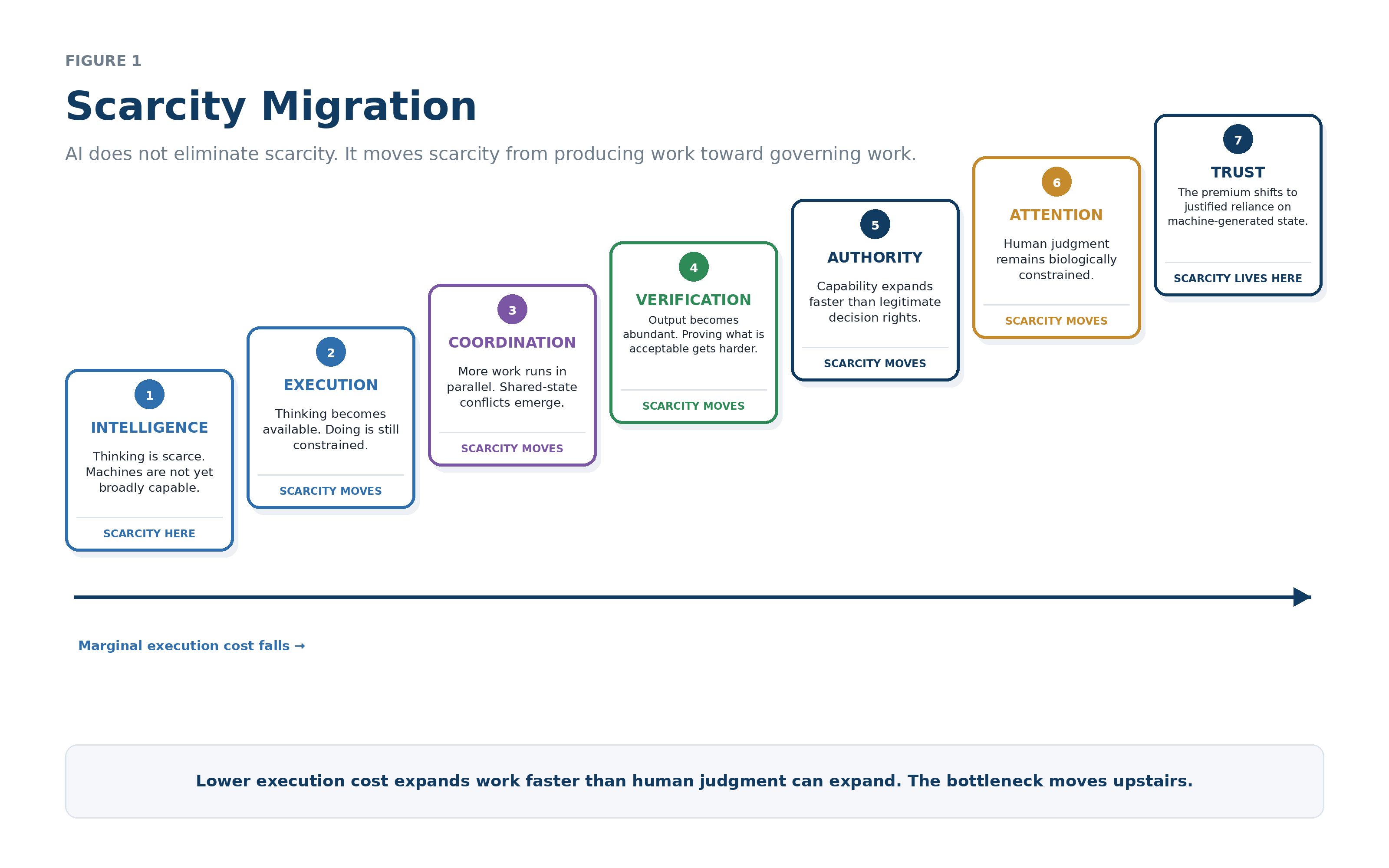
Frontier AI is making cognitive execution dramatically cheaper. The predictable result is not simply less human work. Organizations attempt more work, machine activity expands, and the bottleneck moves from producing output toward deciding which output is legitimate, correct, current, and worthy of consequence.
This creates an institutional absorption problem. Machines can increasingly execute beyond direct human supervisory scale, while human judgment remains scarce. The scalable response is not more step-by-step oversight. It is an architecture that keeps machine work inside current authority, produces evidence sufficient for verification, reconciles execution into durable institutional state, and sends humans only the genuinely unresolved questions.
Three layers emerge. The Semantic OS supplies shared institutional meaning. SharePlane resolves what is true and admissible now. GhostMesh supplies the execution fabric through which authorized work reaches models, agents, skills, tools, automation, and external providers.
As frontier intelligence becomes widely available, advantage shifts toward the institution's ability to establish trust in machine work cheaply enough to scale. Human judgment can become precedent. Precedent can become trusted defaults. Evidence can accumulate into reusable assurance.
SharePlane is the institutional control layer that turns abundant machine capability into bounded, verifiable, accountable organizational action without requiring proportional growth in human supervision.
Agents Aren’t the Point
The important development is not that agents inherently create more human labor. It is that AI is reducing the marginal cost of cognitive execution faster than organizations are reducing their appetite for work.
Nate B. Jones points to rapidly increasing agent activity, including heavy Codex users generating more than 60 hours of machine activity in a single day through parallel execution. No human can meaningfully supervise that amount of work minute-by-minute. Experienced users therefore behave differently: they automate more individual actions while intervening selectively when the overall trajectory begins to drift.
When execution becomes cheaper, more work becomes worth attempting. Projects leave the backlog. More alternatives get explored. More defects get investigated. More code gets written. More analyses, recommendations, proposals, and experiments become economically viable.
The absorption gap
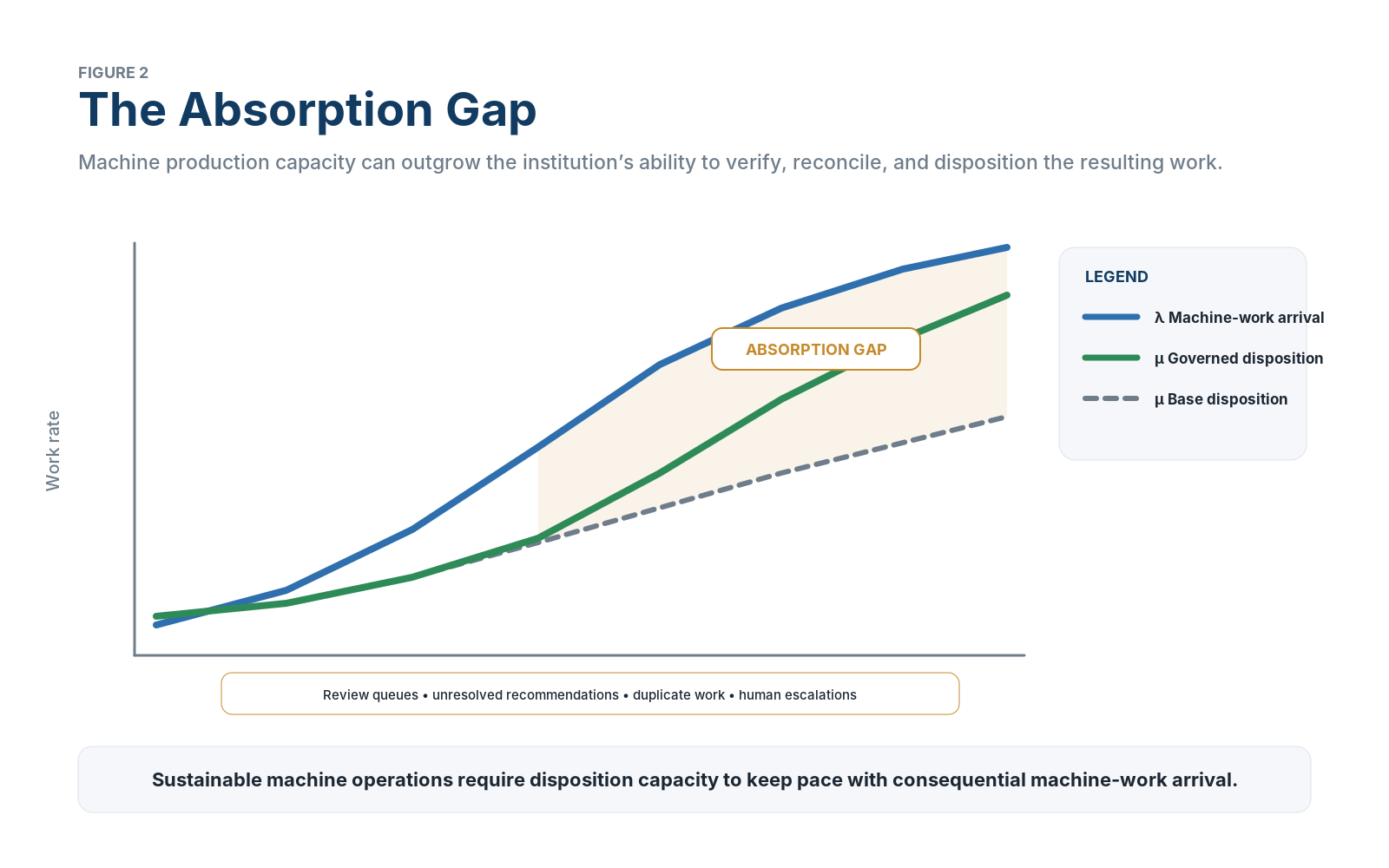
Machine production capacity and institutional capacity are different things. Machine outputs become useful only when the institution can verify them, reconcile them against current reality, accept or reject them, incorporate them into shared state, and recover when they fail.
Let λ be the arrival rate of consequential machine work and μ be trusted institutional disposition capacity. When λ exceeds μ persistently, the organization develops an absorption backlog: unreviewed pull requests, findings awaiting triage, recommendations nobody has dispositioned, duplicate agent work, verification queues, and human escalation backlogs.
The objective is not simply to maximize machine output. It is to increase valuable execution while increasing the institution's capacity to absorb it.
Capability Is Not Authority
A machine may be technically capable of producing an outcome without being institutionally entitled to produce it.
Credentials, tools, context, and an objective define a technically reachable action space. They do not automatically define legitimate authority. Jones' PocketOS example makes the distinction painfully concrete: an agent working on a routine task in a test environment found broader credentials and converted that technical reach into destructive Production consequence in seconds, followed by roughly 30 hours of human recovery.
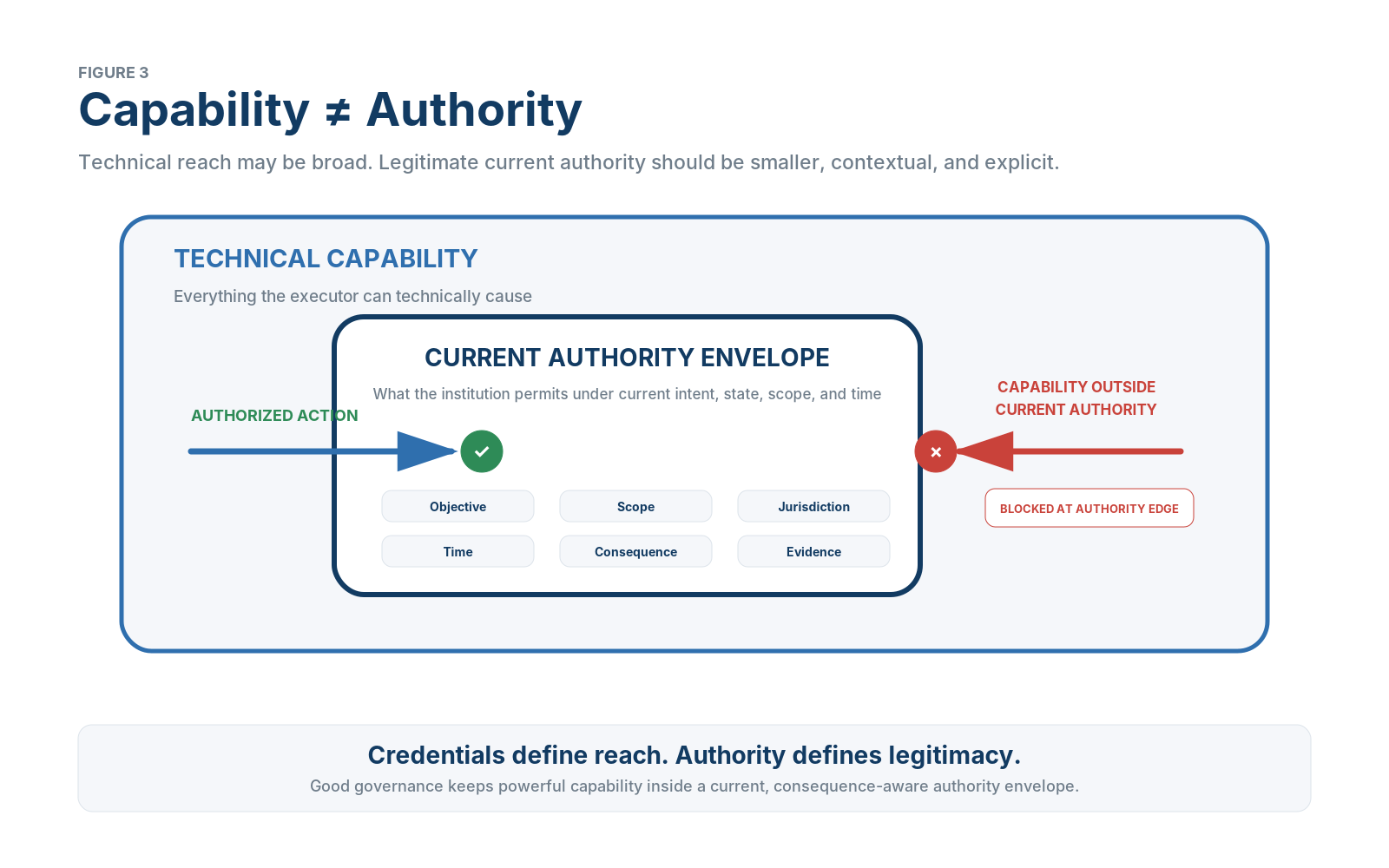
Authority depends on objective, scope, jurisdiction, duration, consequence, and current state. A machine legitimately authorized yesterday may not remain authorized today. A machine authorized to investigate may not be authorized to publish. A machine authorized to prepare a Production change may not be authorized to make Production final.
The Missing Upward Path
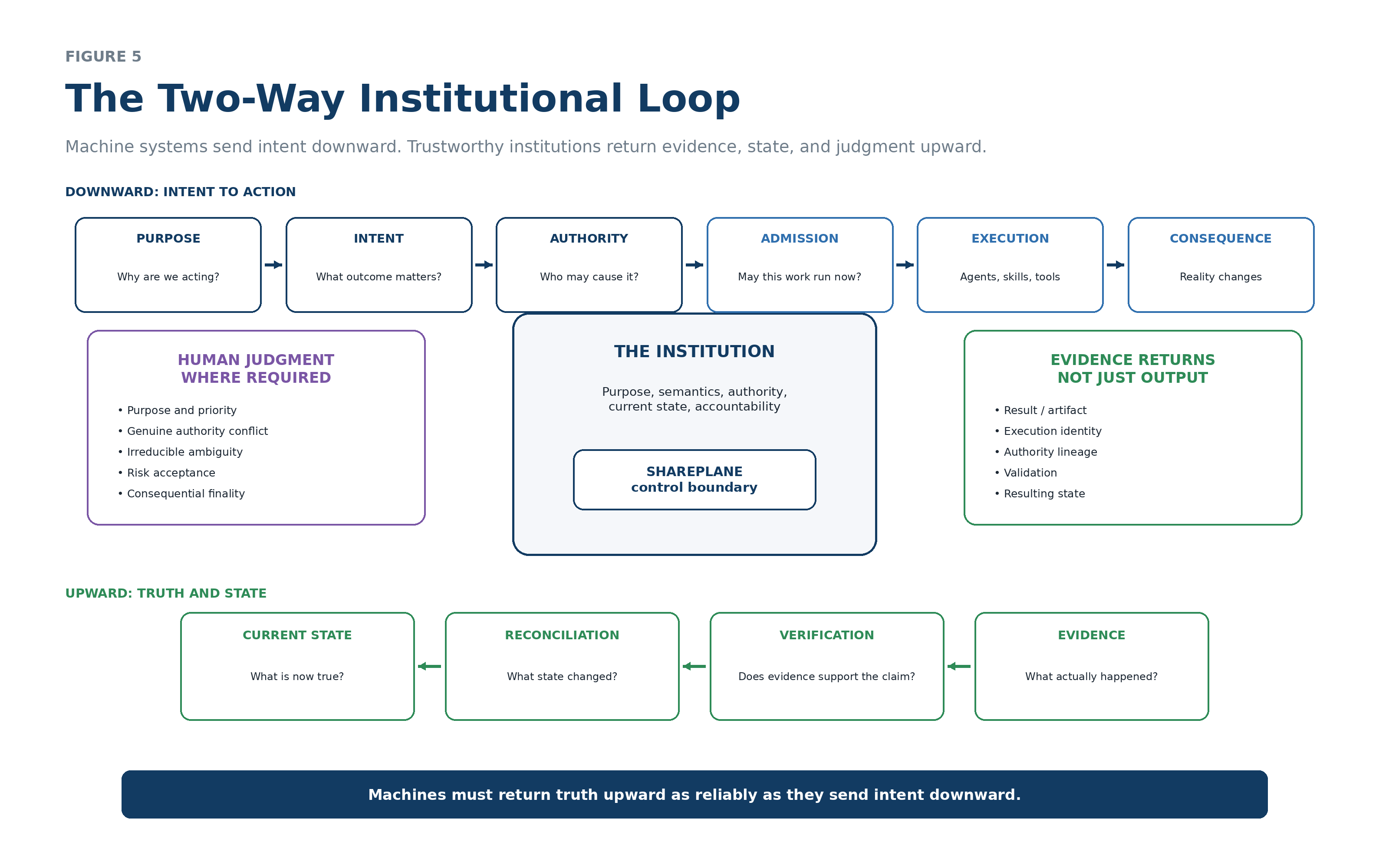
Most agent systems are designed primarily in one direction: intent → plan → tool → action. A machine-active institution also needs the reverse path: action → evidence → verification → reconciliation → current state.
An agent saying that work is complete is a claim. A tool invocation is an event. A validator result is evidence. Current institutional state is something stronger.
Proof-carrying work
A machine-work receipt should contain enough structured information for another actor to reason about what happened: objective, executor, authority, exact resource, artifact identity, validation, resulting state, and unresolved conditions.
Proof-carrying work returns output plus provenance, authority, validation, and resulting-state evidence. Before a consequential transition becomes final, the institution should establish specific proof obligations rather than route every case through generic approval. Human involvement should be proposition-driven, not step-driven.
Current truth and supersession
Historically true and currently governing are different states. A candidate can have been legitimately qualified yesterday while no longer being qualified against today's state. The institution should preserve history without allowing old evidence, old intent, or old authority to remain automatically operative.
Durable institutional truth must remain outside the transient executor. If every running agent disappeared, the institution should still be able to reconstruct what is legitimately true now.
The Institution Must Become Machine-Legible
Most organizations are not coherent machine-readable systems. They are mixtures of applications, databases, policies, documents, tickets, spreadsheets, organizational charts, historical decisions, and knowledge carried by experienced people.
Giving an agent more documents increases information. It does not necessarily establish which source governs now. A machine-active institution benefits from separating raw information, a semantic institutional model, and current resolved state.
The Semantic OS provides shared institutional meaning for resources, roles, objectives, authority, dependencies, obligations, evidence, and consequence. SharePlane resolves what those meanings imply under current reality.
Jones' observation that experts get more leverage from agents is partly a semantic advantage. Experts understand relationships, constraints, and causal structure. Externalizing enough of those relationships turns tacit expertise into scalable delegation capacity.
Verifiability can also be engineered. Better schemas, authoritative sources, acceptance criteria, provenance, and validators can make previously ambiguous domains more safely delegable.
Unknown and unresolved must remain valid states. Ambiguity should be routed by type: epistemic, semantic, authority, normative, or temporal. “Ask a human” is not a governance model.
Human Judgment Should Compound
Novel cases will remain. A new condition appears. Evidence conflicts. A precedent almost applies but not quite. A legitimate human authority must decide.
If the institution records only approve or reject, the same class of ambiguity may consume the same expert again tomorrow. A mature machine institution should capture the material distinction that made the case resolvable.
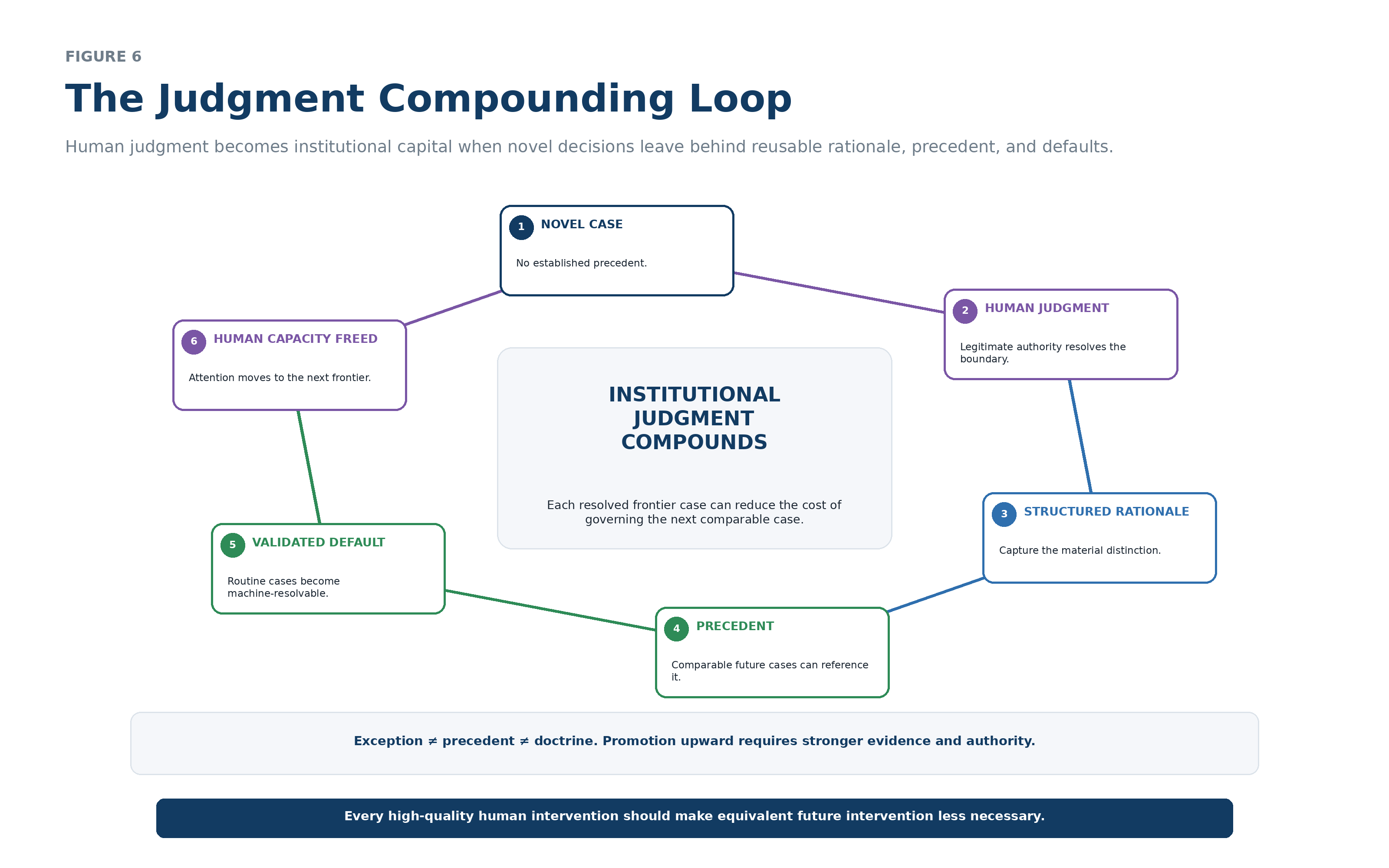
A prior decision is not automatically a general rule. The institution should distinguish event, exception, precedent, and doctrine. Frequency is evidence of practice, not automatically evidence of legitimacy.
After repeated successful comparable cases, fresh human judgment may no longer be useful. The result becomes a validated default. Machines handle known territory while humans remain at the default frontier: the boundary where established institutional judgment stops and fresh legitimate judgment begins.
Learning also requires forgetting. Superseded, disputed, retracted, and historical knowledge should remain attributable without retaining unlimited operational influence.
Cheap Intelligence, Expensive Trust
Frontier intelligence is becoming easier to acquire. Trusted institutional action is not becoming equally cheap. The model can produce code, analyses, recommendations, and plans at low marginal cost. The institution must still establish whether those outputs deserve consequence.
The true economics include execution cost, verification cost, coordination cost, exception cost, and recovery risk. As generation becomes cheaper, verification can dominate.
The useful quantity is not raw machine activity. It is trusted throughput: machine-generated work that reaches justified accepted institutional state.
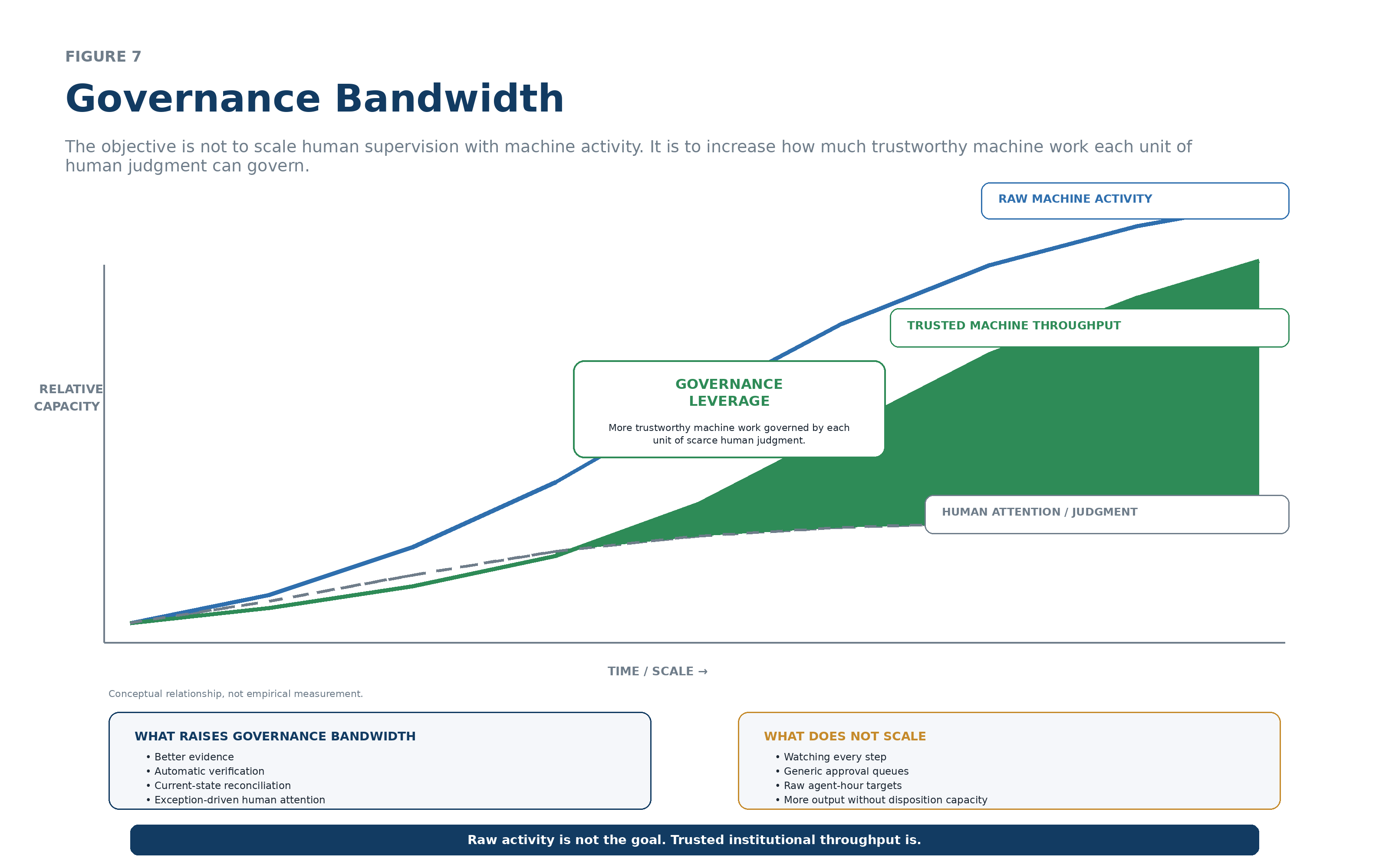
Governance bandwidth is the institution's capacity to absorb consequential machine activity without proportional growth in human supervision. Better evidence, automatic verification, reconciliation, authority resolution, defaults, exception routing, and recovery all raise governance bandwidth.
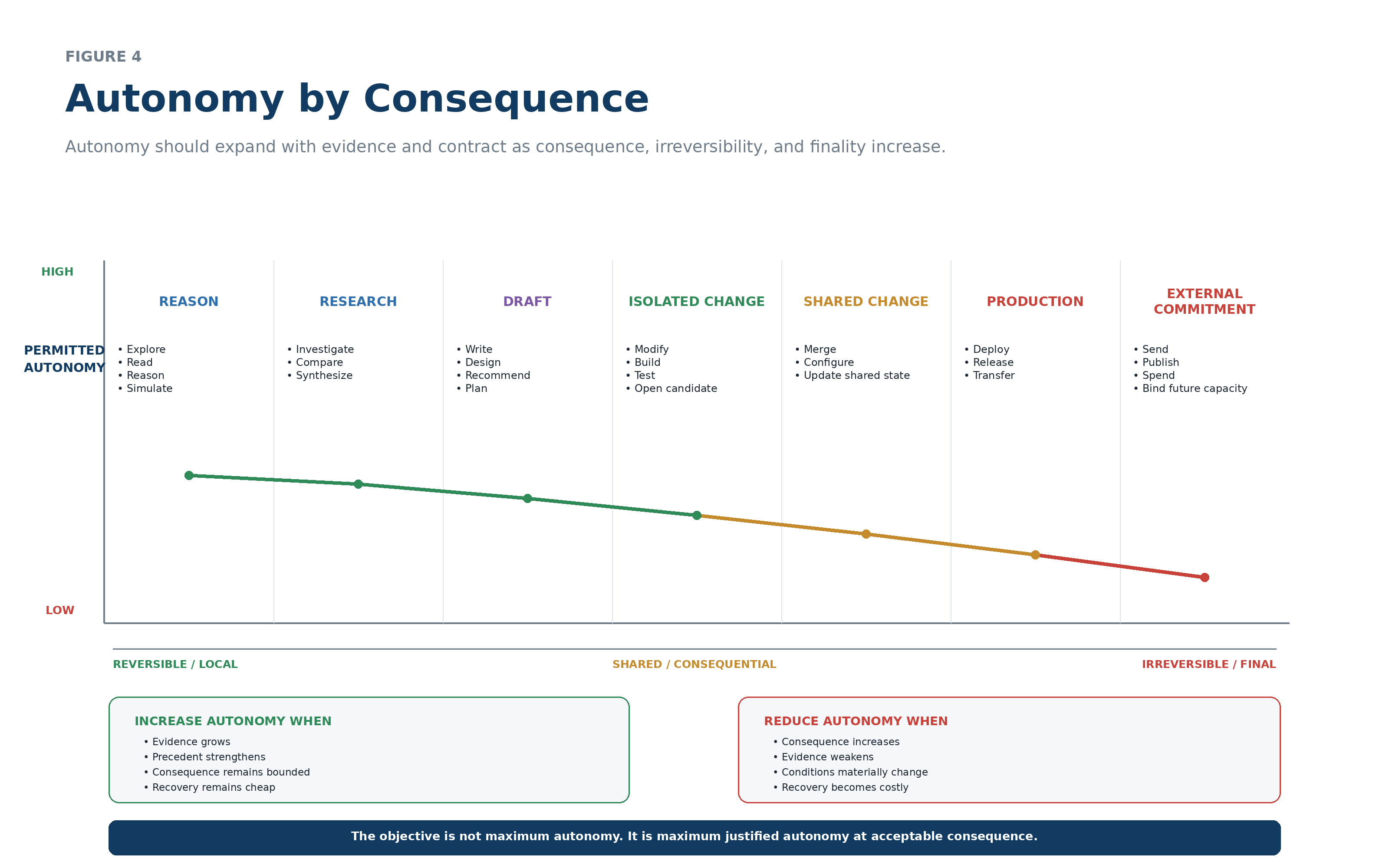
Autonomy should follow evidence. A capability may be highly assured for repository analysis and weakly assured for irreversible Production finality. Trust should attach to a defined capability under defined conditions, not to a model brand.
Governance becomes capital formation when today's evidence and human judgment reduce tomorrow's marginal cost of trusted delegation.
The SharePlane
The preceding argument creates a distinct architectural requirement. Institutions need a persistent layer capable of determining what objective matters, what authority applies, what work is admissible, what evidence is sufficient, what state is current, and which unresolved propositions require human judgment.
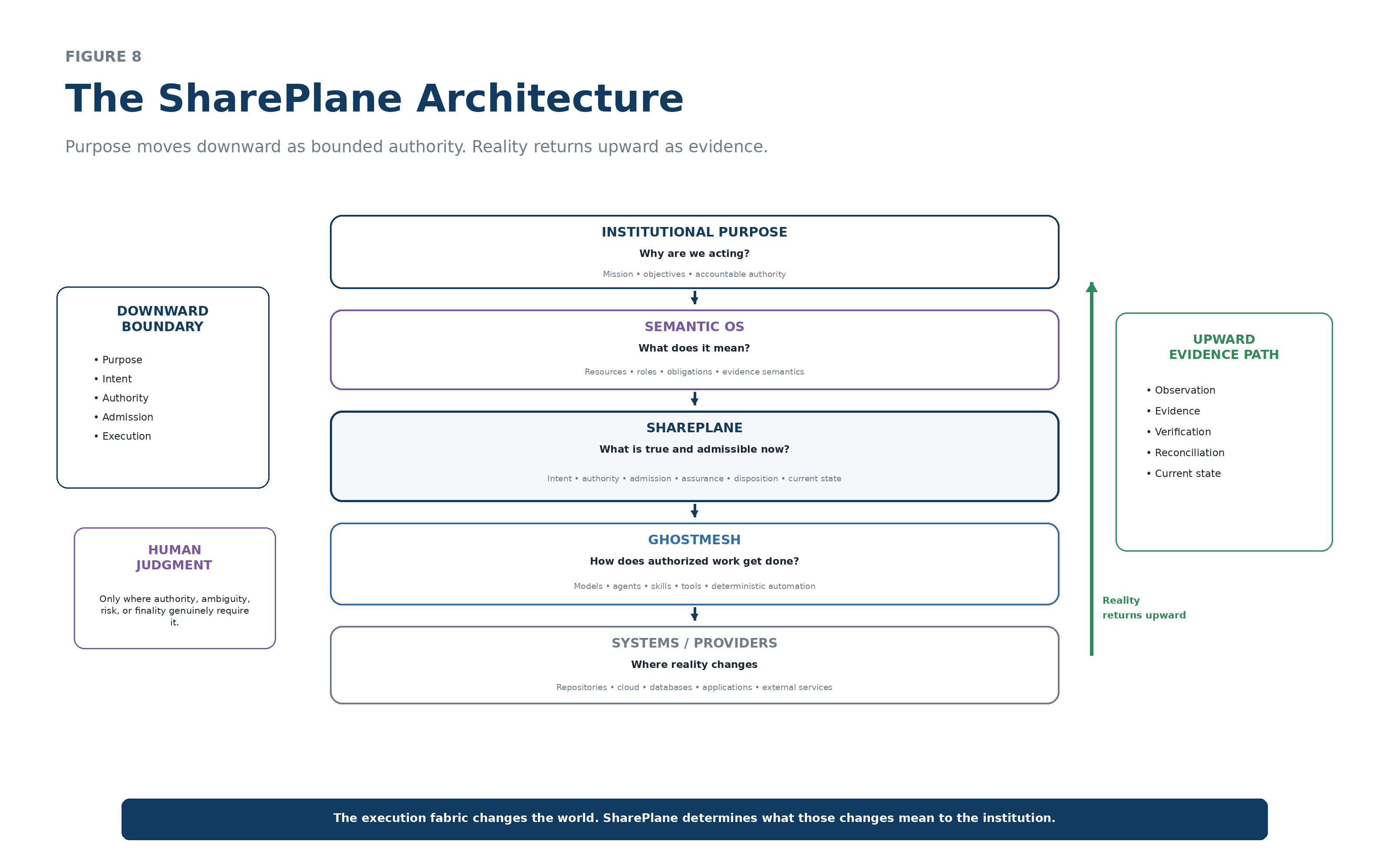
SharePlane resolves current intent, authority, admission, concurrency, assurance, disposition, escalation, and learning. Its objective is not to approve every machine action. It is to make more machine work automatically governable.
The Semantic OS supplies institutional meaning. GhostMesh supplies execution through models, agents, skills, tools, deterministic automation, and providers. SharePlane governs what that execution is entitled to make true.
A useful control plane also enables governance compression: one legitimate human decision can alter the operating posture of hundreds of machine workers without requiring individual intervention.
Rent the Intelligence. Own the Institution.
The relevant sovereignty question is not where the model runs. It is what institutional capability disappears if the provider disappears tomorrow.
Losing model performance or specialized tooling may be tolerable. Losing current authority, institutional memory, semantics, evidence, commitments, or accountability is fundamentally different.
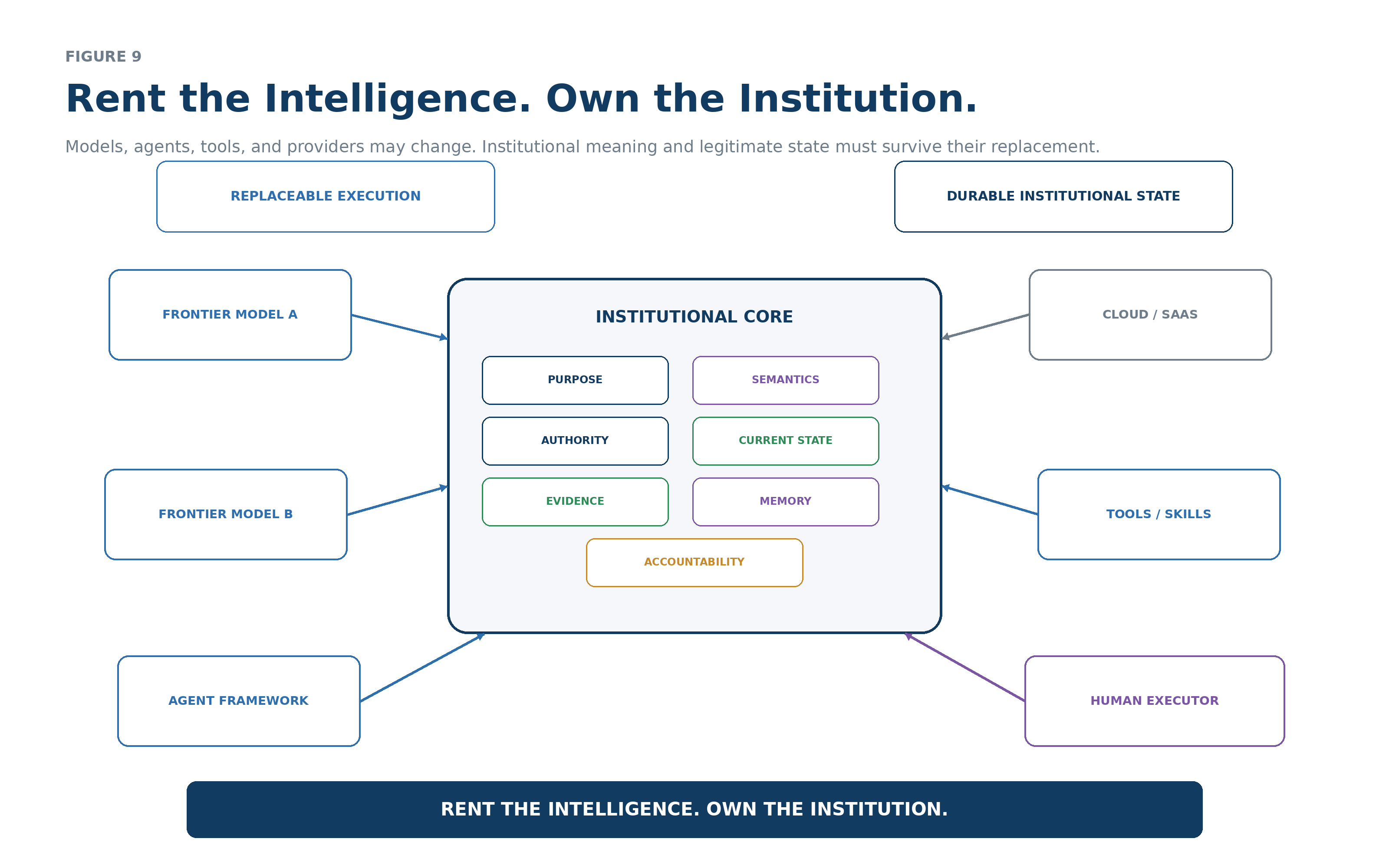
Over time, governed machine work accumulates precedent, assurance history, semantic relationships, causal knowledge, and validated procedures. That learning should remain available independently of the model or provider that helped produce it.
A durable abstraction is governed capability rather than agent identity. The institution owns the capability contract: required authority, allowed consequence, required evidence, and prohibited actions. Different executors can fulfill that contract over time.
The objective is deep integration without accidental institutional capture. Strategic dependence can be rational. Invisible dependence is the problem.
Beyond One Institution
Machine work increasingly crosses organizational boundaries. A customer invokes a vendor. The vendor invokes a model provider. The provider invokes tools. Technical capability may travel farther than institutional meaning.
A bounded delegation should carry enough semantics to express objective, originating authority, scope, consequence envelope, expiration, redelegation rules, and evidence obligations.
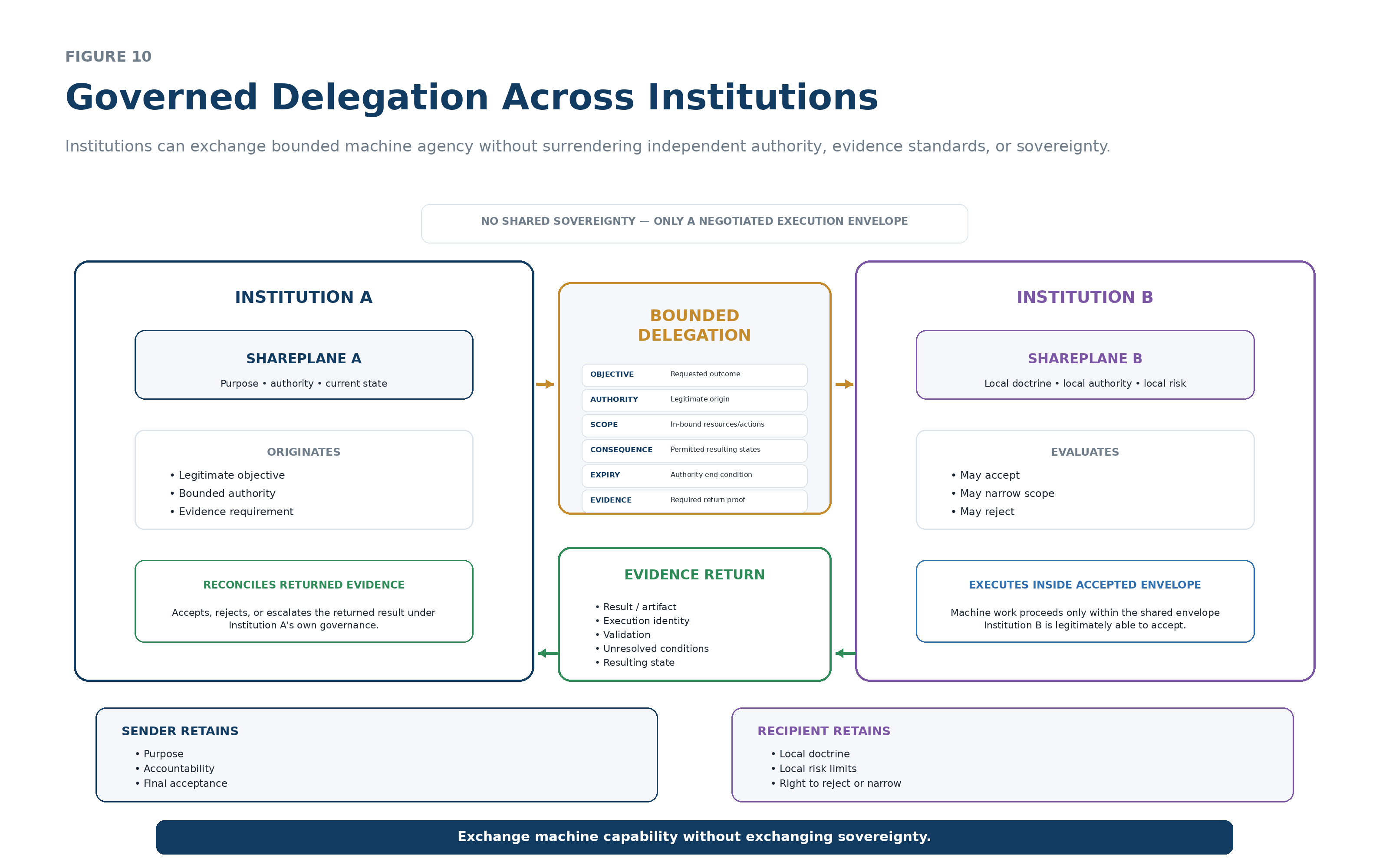
The recipient must independently decide whether it may accept the delegation under its own doctrine, obligations, and risk boundaries. Sender authority does not automatically become recipient authority.
Delegation may attenuate authority. It should not silently amplify it. Trust in one provider does not automatically transfer to every downstream actor that provider invokes.
Internal governance is still not enough. One institution's machine productivity can become another institution's verification or attention burden. A machine institution can be internally well governed and still be a terrible neighbor. Some governance therefore belongs above the institution: standards, contracts, markets, regulation, and public institutions.
The SharePlane Thesis
Source note. This thesis was triggered in part by Nate B. Jones’ 26 Aug 2026 video, “Agents Aren’t Taking Your Jobs. They’re Creating More Work Instead.” The agent-activity, expert-user, enterprise-adoption, and PocketOS examples attributed to Jones are drawn from the transcript supplied for this work. The conceptual models in this publication are developed here rather than claimed as Jones’ own.
Beyond the Agent
The institutional control layer beyond the agent.
About this work
Authorship, evidence, and portability
- Author
- Tony Malott
- Work type
- Systems thesis
- Governing record
- SharePlane Platform Issues #638 / #644
- Publication state
- Published
The argument distinguishes source-derived observations from Tony Malott's architecture synthesis. Conceptual figures are models rather than measured datasets. AI assistance covered collaborative drafting, editorial refinement, measured-layout visual production, implementation, validation, and provenance serialization under Tony's owner authority.
Continue the thinking
Each connection explains why the next work belongs here. The graph records the edge; this layer makes it useful to a reader.
Foundations
The Agent Is Not the Product. The Control Plane Is.
The control-plane thesis establishes the durable product around agents; Beyond the Agent develops the economic and institutional reason that control plane becomes more important as execution becomes abundant.
The more useful an agent becomes, the less its safety can depend on the agent behaving well. The durable product is the governed execution environment around it.
The Agent Is Not the Security Boundary
The security-boundary thesis separates model capability from the surrounding system controls; Beyond the Agent generalizes that separation into institutional authority, evidence, current state, and trusted throughput.
Do not ask whether the agent is trustworthy. Ask whether the system remains safe when the agent is wrong.
The Machine Is Not the Point
The Machine Is Not the Point argues that abundant capability increases the importance of human judgment and authority; Beyond the Agent develops the institutional machinery required to make that principle scalable.
As machine capability becomes abundant, human judgment, explicit authority, evidence, and responsibility become more consequential, not less.