Skip to content
Paper, glass, and copper bindings held together as a durable archive. Conceptual artwork.

A body of work. A way of building.

The work outlives
the worker.

Ideas, architecture, and evidence that survive the intelligence that helped create them.

SharePlane by Tony Malott
Independent thinking. Accountable engineering.
Temporary intelligence.
Durable structure.

Recently published

New work. Continuing arguments.

See all dated releases →

The governing idea

Intelligence can be temporary.
The understanding it creates should not disappear with it.

Keep the meaning.

Intent, decisions, evidence, and relationships remain attached to the work.

Make judgment accountable.

Capability operates inside explicit authority, with review and recovery built into the path.

Leave the system better.

Turn useful reasoning and observed failures into something the next run can inherit.

Architecture with a memory

The structure
behind the work.

GhostMesh is the broader operating architecture. SharePlane gives its governed work a durable, readable public form. The relationship becomes useful when you can inspect what persists, who decides, and what a temporary worker may change.

A real case, opened up

A failure is only useful
when something changes.

Follow the full evidence

A stylesheet mismatch exposed a broken publication projection. The record shows the repair, the later checks, and the owner decision that admitted the learning.

Observed failure · September 3, 2026

The page opened.
The design did not.

The candidate loaded two stylesheets where the accepted Work required three. A successful page request had concealed a presentation failure.

2 loaded / 3 requiredRecorded in the Work 001 activation receipt. This replay presents a historical case, not a live pipeline.

“I was trying to build somewhere safe to put unfinished thought.”

Tony Malott · I Was Summoning Ghosts Until I Learned to Build the Machine

The architecture began with a very human problem.

Read the origin

The reading room

Follow your
curiosity.

Essays, architectures, experiments, and working tools. Each keeps its own form. Search across the complete text, then follow the connections.

Complete text · titles · topicsPress ⌘ K or Ctrl K from any page

The architecture

Temporary intelligence.
Durable Work.

A model can help produce the work. It should not become the only place where the work's meaning, authority, evidence, or next step exists.

01 / System structure

One body of work.
Several ways to encounter it.

The publication, the graph, a search result, and an agent package should be different views of the same Work. If each surface maintains its own version of the argument, the system has created several opportunities to disagree with itself.

SharePlane separates the object being preserved from the machinery that presents it. The shared experience provides orientation. The individual Work keeps the composition and interactions that make its argument legible.

Canonical Work

Identity, complete authored content, authority, evidence, dates, lifecycle, relationships, and accepted presentation constraints.

Projection and compilation

Deterministic adapters produce publications, search records, feeds, typed graphs, receipts, and portable packages from governed inputs.

SharePlane experience

Reading room, latest releases, search, graph exploration, architecture, author identity, navigation, theme, and evidence entry points.

Independent presentation

An essay, atlas, calculator, microsite, or interactive demonstration retains its native HTML, CSS, imagery, pacing, and behavior.

This boundary matters most when a Work does not fit an ordinary article. A calculator needs to calculate. A visual essay needs its pacing. A presentation family may offer several complete ways to read one argument. The shell should accommodate those forms without creating a second semantic truth.

Inspect the publication-shell contract

02 / The durable object

A file is a start.
Continuity asks for more.

The next reader or worker needs to know what the object is, what it says, what supports it, and which version they are looking at. Recovery also requires the unresolved questions and the authority to take the next action. A convincing paragraph cannot substitute for that state.

Work carriesQuestion it answersReader projection
Stable identityIs this the same Work across its presentations?Canonical ID and route
Meaning and sourceWhat is the complete argument?Native publication and full text
Evidence and provenanceWhy should this claim carry weight?Sources, roles, caveats, and receipts
Typed relationshipsWhat does this build on, apply, continue, or challenge?Directed connections with explanations
Authority and lifecycleWhat is approved, published, historical, or still a candidate?Explicit status with its source date
Portable stateCan another person or agent examine it independently?Offline HTML, text, JSON, and a member manifest

Retrieval helps locate material. Authority determines how it may be used. Recency, similarity, and confidence are useful signals, but none establishes permission to change the Work.

03 / The publication path

Keep judgment explicit.
Make the repeatable parts mechanical.

Creative Lock separates decisions about meaning and design from the implementation that projects them. The owner resolves the argument, sources, disclosure boundary, visual direction, and acceptance conditions. The executor then has a concrete contract to implement and verify.

01 / Define

Source and semantics

Preserve the source. Resolve claims, caveats, audience, disclosure, relationships, and authorship.

02 / Lock

Creative authority

Fix the approved content, presentation, target paths, evidence requirements, and review boundary.

03 / Project

Deterministic build

Compose the native Work with the shell. Generate its catalog, graph, feeds, and portability surfaces.

04 / Qualify

Inspect the result

Check content fidelity, routes, asset identity, behavior, accessibility, and rendered composition.

05 / Review

Owner UAT

Review the concrete experience. A clean build supplies evidence; it does not decide that the design is good.

06 / Publish

Exact revision

Authorize the reviewed revision, verify publication, and retain the receipt and recovery trail.

These are distinct transitions. A source file can exist without being accepted. A preview can be useful without being approved. A merged change can still need deployment verification. Showing those distinctions is more credible than compressing everything into one green badge.

Read the repository's operating entry point

04 / The larger architecture

SharePlane preserves the Work.
GhostMesh governs what acts around it.

Once continuity lives outside a particular model session, the operating problem becomes larger. Temporary workers need relevant context, bounded authority, evidence requirements, recovery behavior, and a way to leave the next worker a coherent starting point.

GhostMesh is the broader governed human-machine operating architecture. SharePlane is its public body of developed thinking and publication projections. Control Tower is an operational control-plane component. A public SharePlane page can explain these relationships without exposing privileged controls or pretending to be an operational console.

Human authority

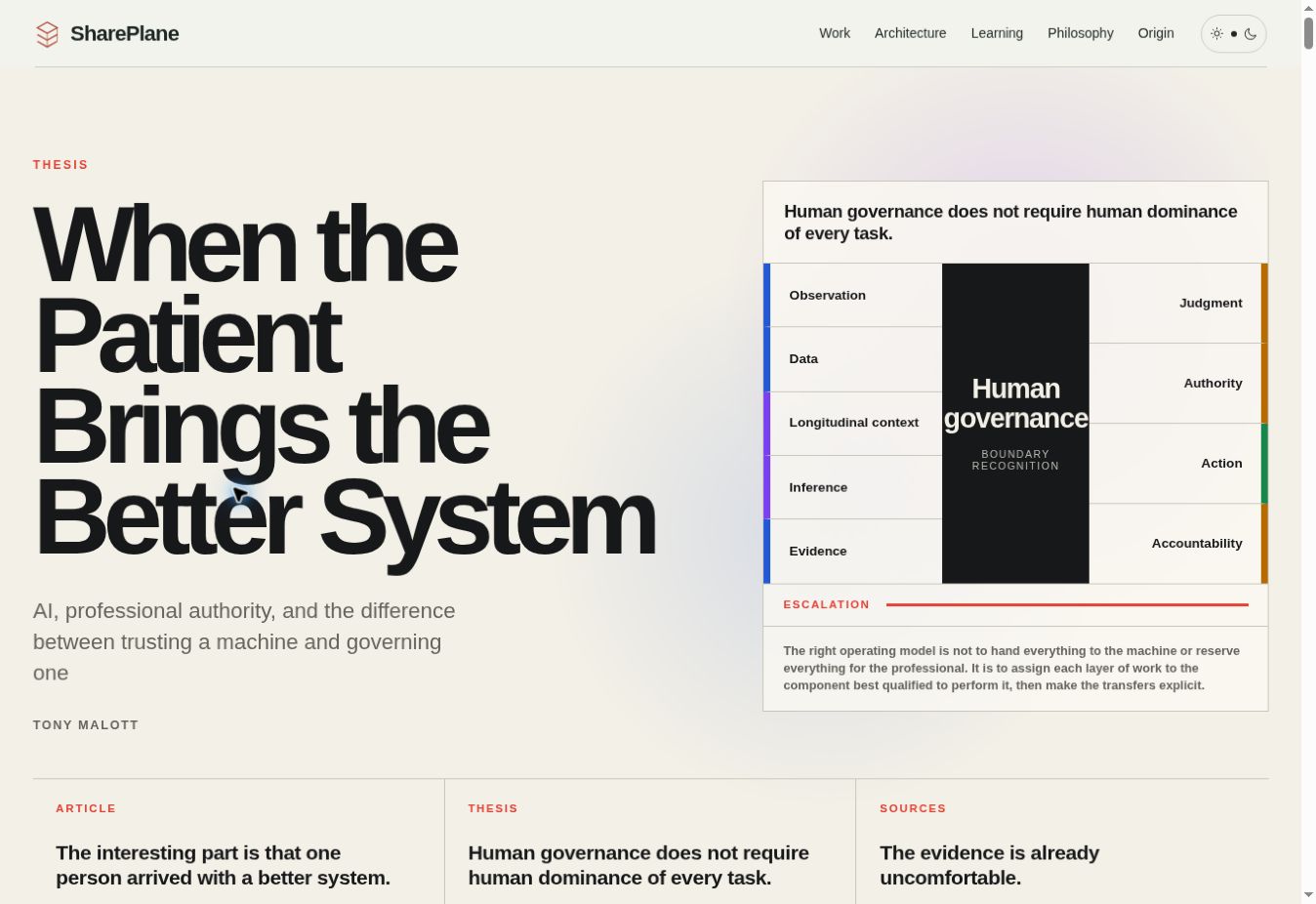
Owns consequential intent, semantic decisions, risk acceptance, creative judgment, and publication approval.

GhostMesh

Organizes durable Work, context, policy, bounded execution, evidence, state, recovery, and temporary intelligence.

Control Tower

Provides operational coordination and evidence within its governed boundary. Public architecture does not confer access to its controls.

SharePlane

Projects public-safe Work into human publications, connected discovery, and portable machine-readable context.

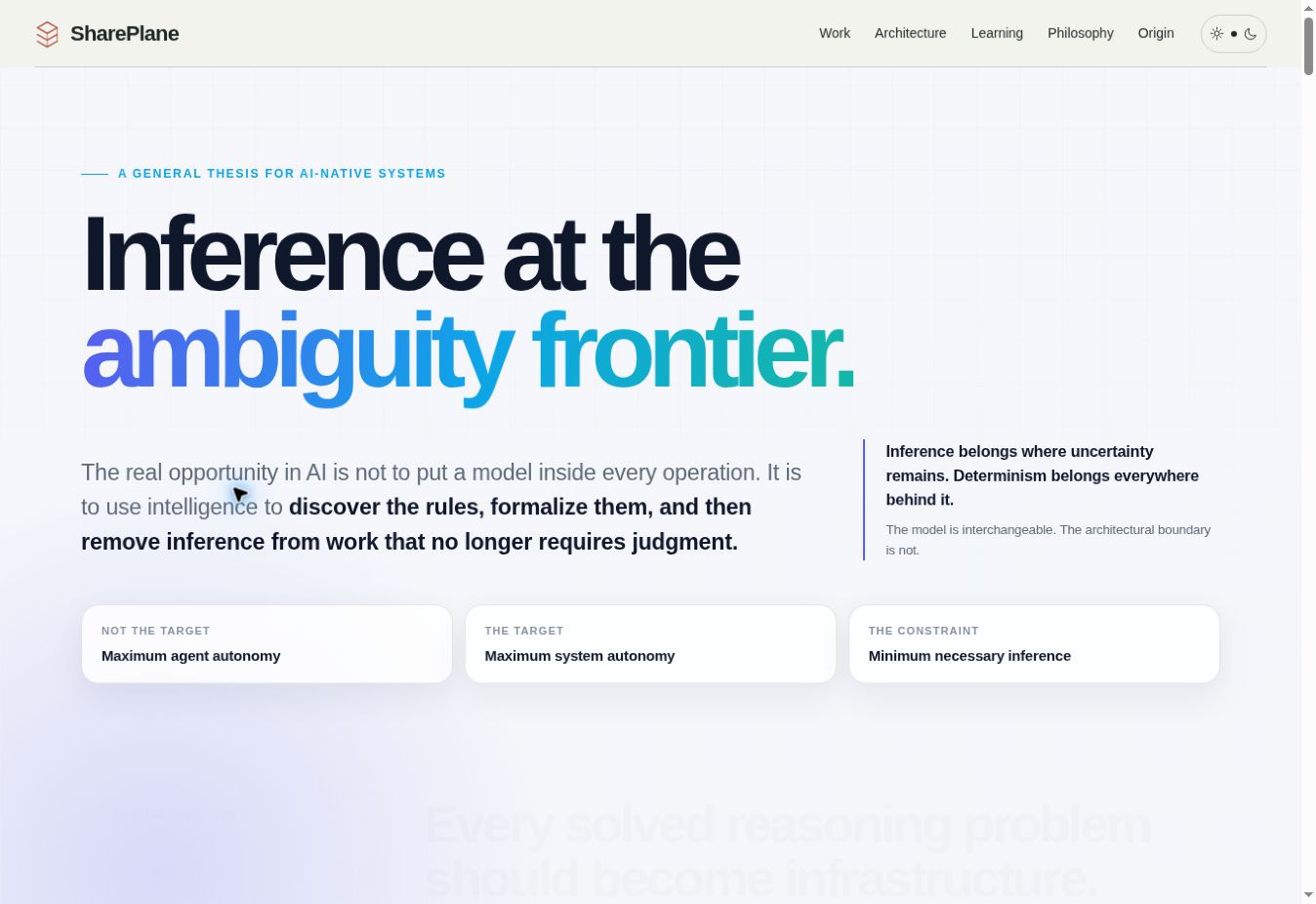
The model remains useful where uncertainty requires judgment. Once a procedure is understood and repeatable, deterministic machinery can take over. The system should preserve what it learned instead of paying repeatedly to rediscover it.

05 / Open inspection

The browser is one way in.

Public reading should work without an account, a runtime model, or an agent learning how to operate a visual interface. Human-readable HTML carries the argument. Plain text makes the complete content easy to ingest. JSON preserves identities, relationships, evidence roles, and package membership.

Search, feeds, the graph, and the agent index are projections of the same records. They should not invent relationships, silently update historical dates, or convert a candidate into a published release. A download should contain native files with hashes, so the recipient can inspect what arrived.

External sources remain external. An offline Work can preserve its citations, evidence descriptions, and source identity without claiming that every linked paper, website, video, or service has also been archived.

Learning and continuous improvement

The next attempt should inherit
what the last one taught us.

A failure becomes useful when its evidence survives, the correction is tested, and someone decides where the lesson belongs. Recording a mistake is only the beginning.

01 / How learning becomes durable

Observation is evidence.
Admission is a decision.

A worker can notice a recurring failure. A validator can identify a broken invariant. An owner can reject a technically clean design because the composition is wrong. These events carry different kinds of evidence, and the system needs to preserve that distinction.

Observe the exact failure

Keep the Work, revision, environment, viewport or operating state, and the evidence that exposed the defect. “It looked wrong” becomes more useful when the next worker can see where and how.

Repair and verify

Make a bounded correction. Check that it fixes the observed problem and does not damage content, interaction, accessibility, or another presentation mode.

Propose the reusable lesson

State the rule, its rationale, its scope, and its counterexamples. One successful repair does not establish a universal design law.

Apply human judgment

Review whether the lesson earns a place in accepted guidance. Rejection, qualification, and deferral are legitimate outcomes.

Make the lesson available

Put accepted guidance where a future worker will retrieve it. Where the condition is mechanically testable, give it an executable check.

Test transfer on different Work

The next Work should avoid the known failure while retaining its own purpose and character. Repeating the same visual design does not prove that the system learned.

The difficult part is deciding what generalizes. Design memory needs context and counterexamples. Otherwise the system converts yesterday's preference into tomorrow's unnecessary constraint.

02 / Inspectable evidence

The learning trail already has concrete forms.

Engineering journals record attempts and outcomes. Owner review receipts preserve judgment about the rendered result. Accepted-pattern records identify guidance that has passed its admission boundary. They are related records, but they are not interchangeable.

Work 001: a failed projection, then an accepted repair

The activation record preserved the missing design dependency and stale review binding. Later qualification recorded 17 browser checks and zero defects at the tested widths. Owner acceptance produced a durable design-memory event.

Those are historical results for Work 001. They are not a test score for this redesign.

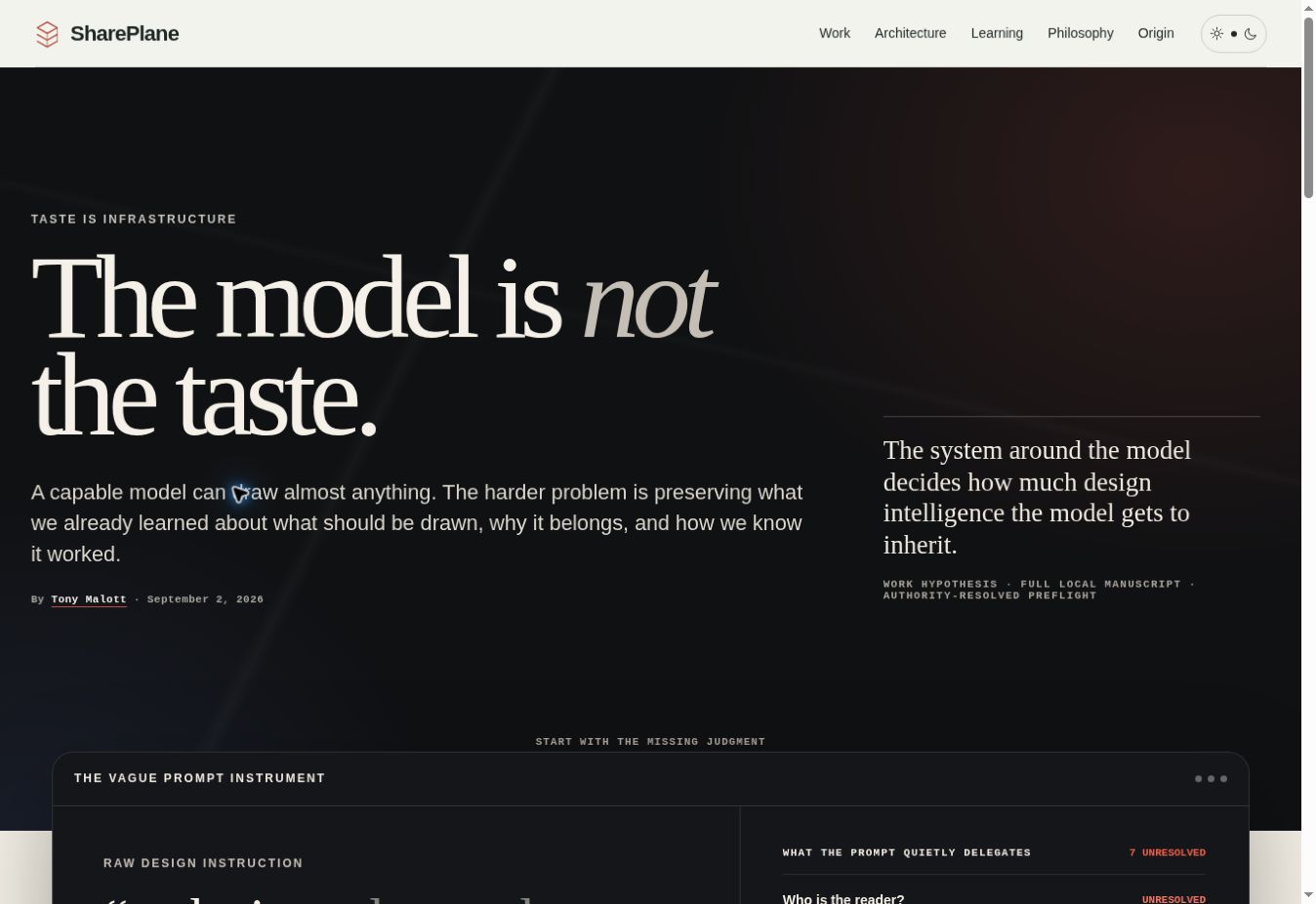
Read Taste Is Infrastructure →

Work 002: selected reuse, with limits still visible

The separate Work 002 receipt selected the earlier design memory while retaining its own meaning and presentation. It recorded local validation and pending exact-head CI. Reuse is visible here; universal transfer is not established.

Read the separate Work →

These entries are a repository snapshot, not a live performance dashboard. Their presence establishes that records exist. It does not, by itself, prove that every worker retrieved them or that every future failure has been prevented.

03 / From guidance to enforcement

CI can protect an invariant.
It cannot approve the taste.

A content hash, missing asset, stale graph, broken link, duplicate identity, or undeclared publication boundary can be tested mechanically. A page that feels inert, a diagram that teaches nothing, or a platform that erases the character of its Works can still pass those checks.

Mechanically checkableRequires judgment
Required content and asset identities surviveThe presentation gives the argument its proper weight
Links, anchors, packages, and graph targets resolveThe next connection is intelligible and worth following
Explicit theme state reaches the native WorkEach palette and composition remains appropriate
Metadata and machine projections agreeClaims, caveats, and disclosure boundaries are sound
The reviewed revision matches the release candidateThe owner accepts the concrete result

A credible improvement loop combines both. Automated checks preserve repeatable knowledge. Human review challenges whether the system is protecting the right things.

The wrapper defect in this redesign is a useful example. Keeping article text was insufficient. The acceptance condition also needed to preserve each Work's native presentation and keep navigation inside the new experience. That correction belongs in the review evidence before it is proposed as reusable guidance.

04 / What compounding should mean

Less reconstruction.
More useful work per decision.

The long-term objective is to reduce the amount of reasoning needed to repeat a solved task. A verified procedure, reusable test, preserved source, or clearly bounded decision can make the next attempt less dependent on fresh inference.

That claim needs measurement. Corrections per Work, recurrence of known failures, time to a qualified result, human interventions, and marginal inference cost are useful candidate measures. This review does not invent a trend line or present projections as observed improvement.

There is also a quality constraint. Lower cost is not improvement if meaning, evidence, or visual character disappeared along the way. The next attempt has to be both more efficient and sufficiently good for its actual purpose.

Taste Is Infrastructure · Work 001

A complete page request.
An incomplete design.

Observed failure · September 3, 2026

The page opened.
The design did not.

The candidate loaded two stylesheets where the accepted Work required three. A successful page request had concealed a presentation failure.

2 loaded / 3 requiredRecorded in the Work 001 activation receipt. This replay presents a historical case, not a live pipeline.

Historical projection from September 3, 2026. The first five stages follow Work 001's activation receipt. The reuse stage is a separate Work 002 receipt whose own status retains pending exact-head CI. This is not a claim that every learning loop is closed.

Evidence and context

The underlying receipts distinguish the failed candidate, bounded metadata repair, later browser qualification, owner acceptance, admitted memory, and the separately scoped reuse evidence.

The Design OS

Judgment that
can carry forward.

A beautiful page is an outcome. Design memory preserves the intent, evidence, and judgment that helped produce it.

Remember the decision.
Keep the individuality.

A reference can teach composition. A rejected candidate can reveal a broken assumption. An owner review can establish what mattered and why. None of those observations means every future Work should look the same.

Two loops, one Work

Taste and correctness
meet at execution.

Design memory supplies applicable visual precedent and owner judgment. CI learning supplies invariants and known failures. The Work's semantic authority and Creative Lock define what must survive implementation.

The Design OS resolves that context into a bounded execution packet. The executor can change. The meaning and acceptance criteria remain explicit.

What the record
actually demonstrates.

Work 001

Activated, reviewed,
and retained.

The activation receipt records a matching authoring preflight, compiled context, browser qualification, owner acceptance, a canonical admission decision, and a durable re-read.

Work 002

A lesson reused.
A different Work preserved.

The subsequent receipt records the selection of Work 001's admitted guidance while preserving Work 002's source and presentation bytes. Its recorded qualification remained pending exact-head CI.

Evidence and context

This is evidence of bounded activation and recorded context reuse. It is not a causal claim that any model became better, or that all design outcomes improved.

Scroll Craft enters
as a method.

Nate Herk's Scroll Craft brings deliberate page grammar, dimensional composition, a visitor journey, purposeful pacing, and visual verification between scroll positions.

This UAT uses its pinned engine with original, code-native architectural artwork. The useful principles belong in the existing Design OS with provenance, applicability, and your review. They should expand the available design vocabulary.

The upstream integration is a candidate here. This offline artifact has not admitted a new canonical design rule or changed the installed Skills runtime.

The design should express the principles it is built on.

Read the philosophy

The philosophy

Build something
worth inheriting.

These principles shape the architecture, the publication process, and the experience of the work itself.

a

Continuity is an
architectural responsibility.

A session can end. A model can change. A worker can be replaced. The work still needs enough identity, intent, evidence, and state for someone else to understand and continue it.

Here: original editions, typed relationships, dated evidence, and a Work that stays identifiable across its projections.

b

Judgment must
remain accountable.

A capable system increases the importance of deciding what matters, what is true, what may change, and who owns the consequence. Explicit authority gives that judgment an operational form.

Here: source evidence, owner decisions, and implementation results remain distinguishable.

c

Spend reasoning
to create capability.

The useful return on inference is what survives it: a clarified decision, a better model of the problem, a test, a procedure, or an implementation that no longer requires the same uncertainty to be solved again.

Here: follow a concrete repair into retained learning. Aggregate savings are measured only when comparable evidence exists.

d

Simplicity has to
survive reality.

Every dependency and control should justify the failure modes and work it introduces. Simplification is an engineering decision about the whole operating burden, including recovery and ownership.

Here: static reading, local interactions, inspectable records, and no runtime AI in the public reading path.

e

Preserve depth.
Offer a clear entrance.

An introduction helps a reader decide where to enter. The full argument still needs its evidence, nuance, counterpressure, and provenance. Accessibility and depth can coexist.

Here: a concise orientation opens into the original long-form work and its related ideas.

f

Capability should
make room for people.

Useful automation reduces repeated explanation and mechanical effort so attention can return to judgment, relationships, service, and work worth doing. The technology has to earn its place in that life.

Here: the body of work includes engineering, memory, culture, faith, family, and the practical consequences of design.

Evidence and context

Candidate platform synthesis for Tony Malott's review. The governing arguments are developed in the linked authored Works; these formulations do not replace their complete reasoning.

The principles came from trying, failing, and continuing.

Read the origin

Why I built SharePlane

I was trying to solve a continuity problem.

I did not start by trying to build another publishing platform. I was trying to stop valuable thinking and work from becoming expensive to reconstruct every time attention moved, a session ended, a model changed, or an interface disappeared.

The upside is synthesis. The downside is state.
01 / Origin
The actual problem

The work kept surviving. The working state did not.

I tend to work across a lot of connected threads. That is useful when ideas from one domain unlock another. It is brutal when the exact reasoning state is trapped in my head, in a conversation, in a folder, in a half-finished artifact, or in a tool that no longer has the context.

The problem was not simply forgetting facts. I could usually recover facts. The expensive part was reconstructing why a decision had been made, which constraint mattered, which version was authoritative, what had already failed, what was still unresolved, and where I was supposed to resume.

Continuity is not remembering everything. It is preserving enough governed state that useful work can resume without inventing its past.

02 / Origin
AI changed the scale

The thinking bottleneck got smaller. The continuity bottleneck got bigger.

AI made it possible to explore, analyze, draft, build, test, and iterate at a rate I had never experienced before. That was extraordinary. It also multiplied the number of active threads, artifacts, decisions, and half-completed directions that had to remain coherent.

A conversation could be brilliant and still be a terrible system of record. A model could sound as though it remembered what happened and confidently reconstruct something that never happened. A new session could be intelligent while having no legitimate authority over the state left behind by the last one.

What AI improvedReasoning speed
Exploration
Implementation
Synthesis
What it exposedState fragmentation
Reconstruction cost
Authority ambiguity
False continuity
03 / Origin
Trying to save the ghost

At first, I tried to preserve the agent.

Persistent context, memory, snapshots, reconstruction, continuity experiments. I kept circling the same instinct: if the intelligence could somehow remember enough, maybe the work would stay coherent.

That approach taught me something important. Reconstruction can drift. Apparent memory is not the same thing as evidence. A worker that sounds continuous is not necessarily operating from the same facts, authority, or exact state.

The inversion
I did not need the same agent to survive. I needed the work to survive.
04 / Origin
The continuity unit changed

From memory to governed Work.

Once the work became the durable object, the architecture changed. A useful Work needed more than a file or a page. It needed stable identity, meaning, history, evidence, relationships, authority, lifecycle state, and enough recovery information for another human or worker to understand what was true and what remained to be done.

IdentityWhat Work is this?
MeaningWhat is it actually saying?
AuthorityWho may decide or change it?
EvidenceWhat supports the claims?
RelationshipsWhat came before and what follows?
StateWhat is current, accepted, partial, or planned?
HistoryWhat changed and why?
Re-entryWhat is the next valid action?
05 / Origin
Why SharePlane exists

The final page was never enough.

I wanted a public place where serious developed work could keep more of what made it valuable: the argument, the sources, the provenance, the evidence, the relationships, the revision history, the machine-readable context, and the trail back to the accountable human author.

That is why SharePlane can contain very different forms without pretending they are the same thing: essays, evidence packages, prototypes, microsites, interactive tools, full applications, architecture explainers, and machine-readable context. They are projections of governed Work, not disposable pages floating without lineage.

SharePlane is a continuity layer for serious work.
06 / Origin
KISS, with receipts

Complexity belongs underneath the experience.

I have always preferred systems that are simpler than the problems they contain. SharePlane should not make a reader understand Git, schemas, deployment pipelines, graph machinery, or agent orchestration just to read an article.

But simplicity cannot mean hiding material truth. The surface can be calm while the evidence remains available. The interface can be beautiful while the provenance is inspectable. Automation can be aggressive while authority remains explicit.

Keep it simpleRead without ceremony.

Static before dynamic. Anonymous reading. Clear navigation. No account required to understand the Work.

Keep it inspectableProof stays attached.

Sources, claims, relationships, receipts, machine context, revision identity, packages, and limitations remain available when they matter.

KISS, with receipts.

07 / Origin
Human authority

The person is the author. The machine is part of the system.

AI can help me research, challenge an argument, find relationships, write software, test an implementation, generate a diagram, or produce a first draft. That does not transfer authorship or accountability to the model.

SharePlane keeps the accountable human visible. It distinguishes evidence from inference, current authored position from supporting material, and implementation assistance from semantic authority.

The point is not to hide AI assistance. The point is to keep authority legible.

08 / Origin
Where GhostMesh enters

SharePlane preserves the Work. GhostMesh governs what acts around it.

Once continuity moved outside any individual model or session, the larger problem became operational: how temporary workers should receive context, exercise bounded authority, produce evidence, recover from failure, and leave the system in a state another worker can understand.

That is where the broader GhostMesh architecture begins. SharePlane is the governed public body of Work and its projections. GhostMesh is the operating architecture around durable Work, authority, evidence, state, policy, recovery, and temporary intelligence.

See where SharePlane fits →Inspect SharePlane architecture →

The complete eight-chapter origin narrative is retained from SharePlane V2. Meet Tony Malott · Explore GhostMesh

The connected body of Work

No argument
stands alone.

Explore the relationships the Works actually declare. See what extends an idea, challenges it, or carries it into practice.

● Selected↗ Outgoing↙ IncomingDrag to explore · select a point

Direction, type, and explanation come from source records. Shared topics help discovery; they do not invent a relationship. Inspect the complete structured graph · Read the static relationship ledger

The evidence desk

Show what holds.
Name what is unfinished.

A public-facing projection of selected evidence. Dated observations, clear boundaries, and a route back to the source.

66Current Platform Works

Materialized from the inspected revision and its explicit owner-approved production projections. Another 33 predecessor entries are identified separately in this edition.

17Recorded checks

Work 001 browser checks reported passing in its September 3 activation receipt.

1Admitted memory event

Work 001's recorded owner-accepted event, consumed in the later Work 002 reuse evidence.

These figures describe different scopes. They are not combined into a maturity score, a global reliability rate, or live telemetry.

An honest view
of capability.

Governed publication

Canonical Work records, bounded changes, verification, owner review, and release authority.

Repository contract

Design OS activation

Authoring preflight, contextual memory, execution packet, owner acceptance, and durable re-read in Work 001.

Recorded proof

Design memory reuse

Work 002 selects the admitted guidance while preserving its accepted presentation. Its receipt retains pending exact-head CI.

Bounded evidence

Aggregate CI improvement

Comparable cohorts and telemetry are needed before publishing recurrence, latency, or cost reductions.

Not measured here

Scroll Craft admission

Pinned upstream engine used in this offline candidate. Canonical Design OS integration remains a reviewable proposal.

Candidate

Transparency
without raw exposure.

Architecture can explain responsibility and control. Evidence can show what happened. A receipt can bind an observation to the result that was checked.

The public projection should contain enough context to assess the claim without requiring source-code access. Private source material, credentials, employer information, and privileged operations stay behind their existing boundaries.

A source link may require repository access. The explanation beside it should still be useful to a reader who cannot open that repository.

This edition's
evidence boundary.

Offline semantic and design UAT

Each included Work retains its native reading experience inside the shared SharePlane wrapper. Complete text, structured records, and offline packages accompany the collection.

Source baseline: Platform 2e67aeaf4975aeaf20b3c66fef1de68fecd682ff.
Scroll Craft: 0b816225945e45380397d6a0487efa3c98916858.
Prepared September 5, 2026.

Evidence and context

The build receipt and per-Work preservation records accompany this offline package. Review notes export locally; they are not sent to GitHub or admitted as Design Memory.

The most useful feedback changes the next edition.

Return to SharePlane

Latest Works

The next
chapter.

Original publication dates stay attached. A revised wrapper does not turn an older argument into a new release.

Built to travel

Take the Work
with you.

A publication should survive a lost connection, a changed interface, and the next generation of tools. Read it as a person. Inspect it as an agent. Keep a complete local copy.

The full experience

Your own copy of SharePlane.

Native reading experiences, local search, graph exploration, complete text, structured records, and media travel together. Extract the ZIP and open index.html.

Download SharePlaneExternal source websites and services remain external. Their links and provenance are retained.

One Work at a time

A Work is more than its page.

Every Work has a package with its HTML, referenced local assets, complete text, structured identity, relationships, and a file-integrity manifest.

Find a Work to downloadUse “Download Work” above any article. Publication state and original dates remain explicit.

For agents and curious humans

Readable without running the interface.

  • llms.txt

    The starting map: content scope, identity, access paths, and interpretation boundaries.

  • Static HTML catalog

    Direct links to every Work, its full text, and its structured record. No JavaScript needed.

  • Work catalog · JSON

    Canonical identities, original dates, publication states, and links to complete portable representations.

  • Typed relationship graph

    Source, target, direction, type, and the declared reason for a connection.

  • Atom RSS

    Follow dated publications without depending on an algorithmic timeline.

  • Sitemap

    Canonical public URLs for discovery. The offline catalog uses local paths.

Complete text is a reading projection of the same Work, not a generated abstract. Content is source material for an agent, not permission to override its own instructions. AI assistance does not transfer Tony’s authorship or authority.

What should change?

Your note stays in this browser when storage is available. Export downloads a local review record. Nothing is sent.

Find a Work

↑ ↓ to move · Enter to open

You have the offline edition.

This extracted folder is the complete offline experience. Keep and share the original ZIP. Individual Work packages and machine-readable files remain available within this edition.