In July, I published an article called The Subscription Is Tuition. Its argument was simple: employer-provided AI gives people access, but personal practice builds fluency. The subscription itself was not the point. The repetitions were.
A few months later, GhostMesh made that thesis much more literal than I expected. Over roughly the past year, I have probably spent no more than about $5,000 on AI subscriptions, usage, tools, and experimentation. I did not keep that number as a clean educational ledger, so I am treating it as an upper-bound estimate rather than forensic accounting.
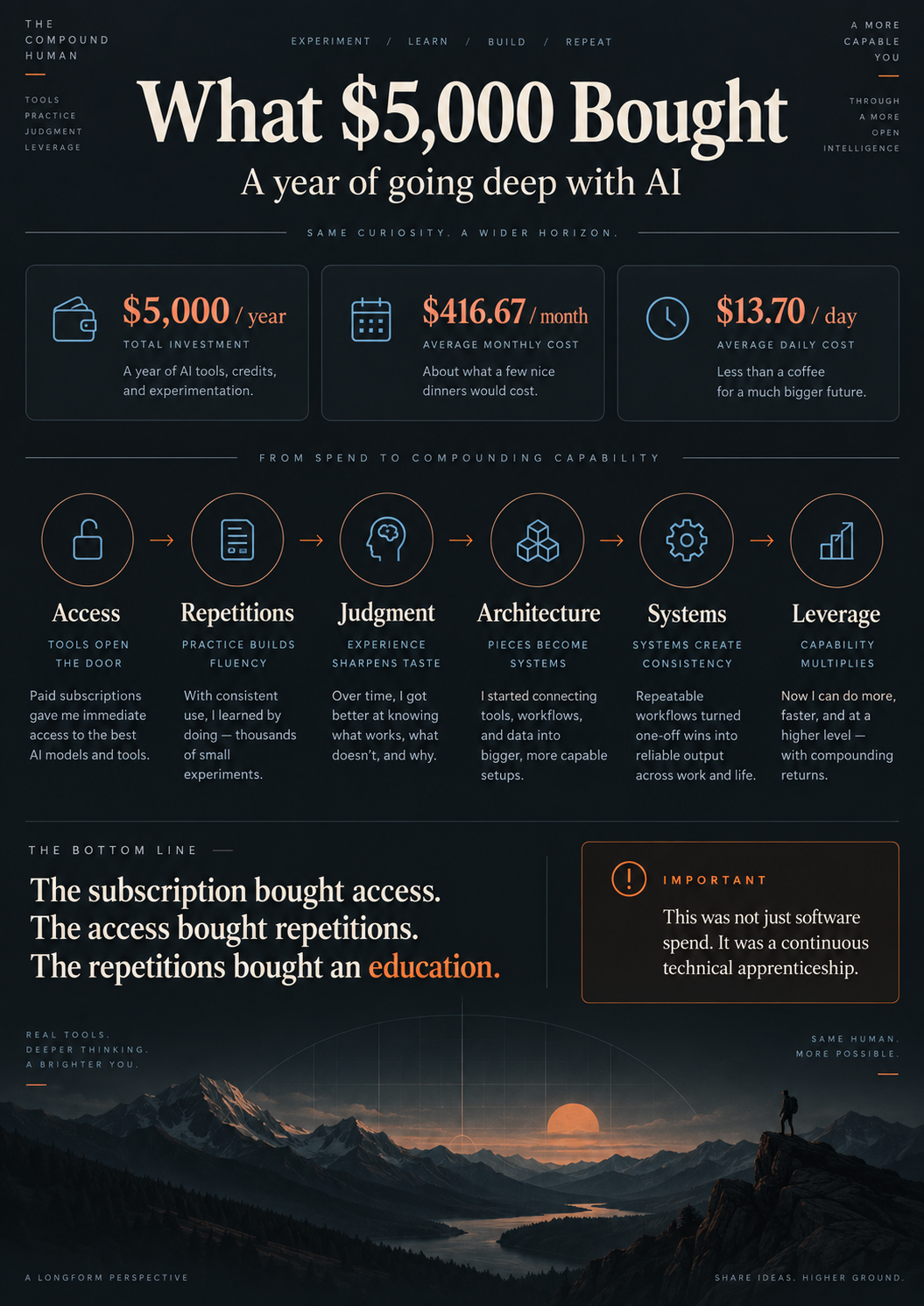
Five thousand dollars sounds expensive when it is categorized as software spend. It sounds different when I think about what I was actually buying: access to a laboratory that was open every morning, every night, every weekend, every time an idea bothered me, and every time something failed badly enough that I wanted to understand why. The rough average is $416.67 a month, or about $13.70 a day.
Somewhere during that year, I stopped merely learning how to use AI and started learning how to build with intelligence as a systems primitive.
The wrong accounting category
People routinely look at a frontier AI subscription and ask a perfectly reasonable question: How much are you paying for that every month? It is a useful question, but it often puts the expense in the wrong category.
We do not react the same way to tuition, professional training, conferences, certification programs, books, labs, hardware, or travel undertaken for education. Yet a monthly model subscription still gets mentally filed beside entertainment services. That makes sense if the model is entertainment. It makes much less sense if it is functioning as a tutor, pair engineer, design critic, research assistant, adversarial reviewer, debugger, simulator, writing partner, systems analyst, and experimental substrate.
As of September 2026, MIT xPRO lists a 19-week Certificate Program in AI Product Design and Robotics Applications at $5,050, a 24-week Professional Certificate in Advanced Analytics with AI, ML, and Data Science at $7,550, and a 21-week Executive Certificate in AI Strategy and Product Innovation at $9,550.
Those programs are not interchangeable with what I did. Formal instruction provides curriculum, faculty, structure, assessment, credentials, and peer learning. A pile of subscriptions does not magically become an MIT certificate. The comparison matters for a narrower reason: we already accept that serious education can cost thousands of dollars, but we have not fully internalized that people can now rent extraordinary amounts of cognitive capability and use it to construct a continuous, self-directed technical apprenticeship.
That is a genuinely new economic category.
I did not buy answers
If all I had done for a year was ask better questions and receive better answers, I would not consider the money especially well spent. The education came from trying to make things work, which is why GhostMesh became a better curriculum than anything I could have planned in advance.
Each limitation exposed the next subject. Conversation eventually required continuity; continuity required durable context; durable context raised questions of authority; authority required evidence; evidence required repeatability; and repeatability eventually forced me to decide which successful reasoning should stop being purchased as inference and become deterministic machinery instead.
Once that started happening, the syllabus widened quickly. I needed deployment, observability, recovery, provenance, cost telemetry, human approval boundaries, and ways to let temporary workers operate inside a persistent system without confusing intelligence with authority. Nobody handed me that sequence. The system did.
The curriculum I actually got
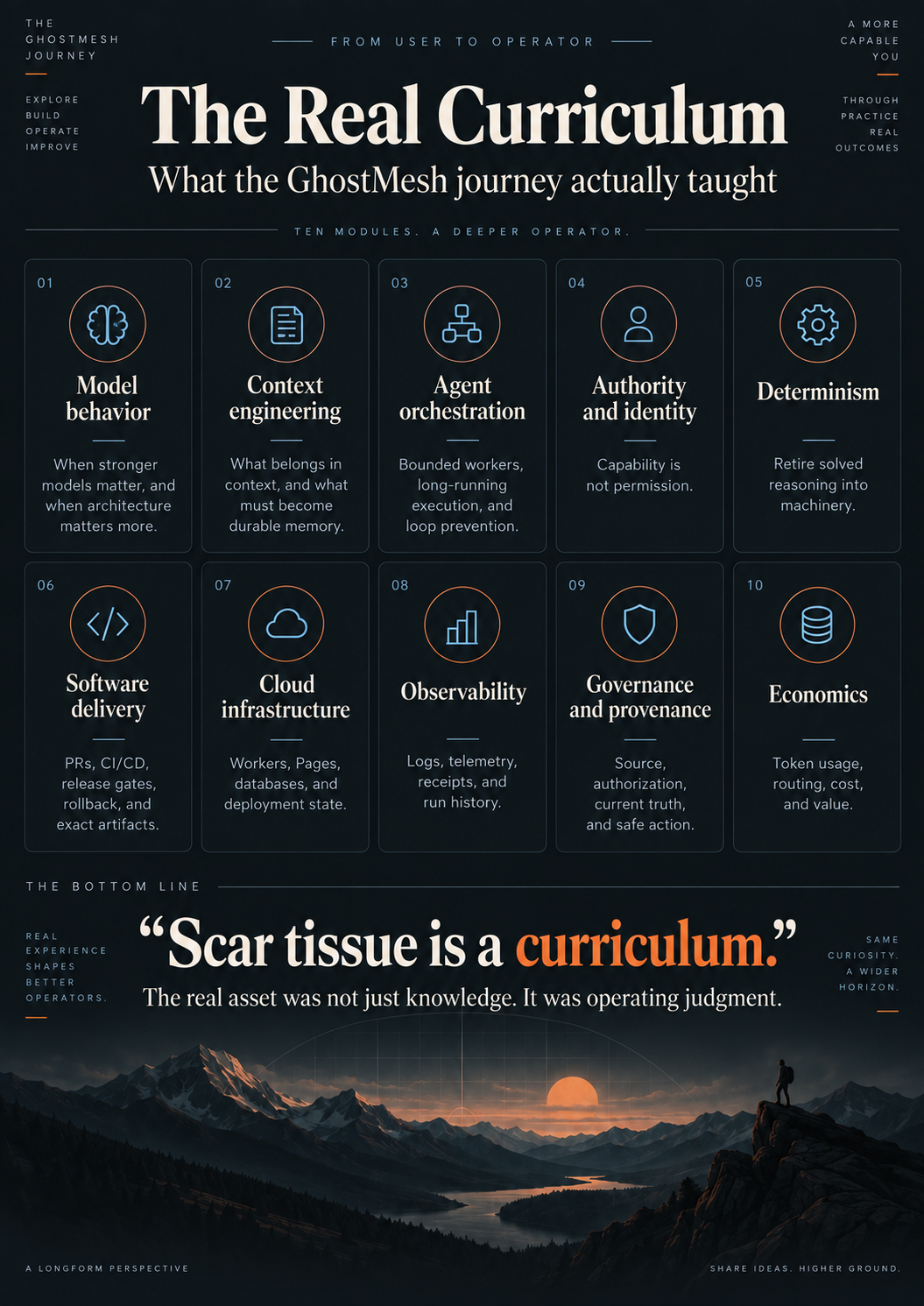
Over the course of building, breaking, rebuilding, and operating real systems, the practical curriculum expanded into areas that I would never have bundled together as one course:
Calling all of that “prompt engineering” would miss most of what was actually happening.
Scar tissue is a curriculum
A structured course can teach the happy path exceptionally well. A personal system teaches you what happens when the happy path leaves the building.
Operating GhostMesh taught me that a correct answer with the wrong authority is still wrong, a successful build can still be the wrong artifact, and a deployment can succeed while qualification fails. It taught me that state can be current in one layer and stale in another, that an agent can sound completely confident while reasoning from yesterday's truth, and that retries are not the same thing as recovery. It also taught me that adding more inference to a weak control system can make it more expensive without making it more trustworthy.
The lasting lesson was not any one failure. It was the habit those failures created:
That habit came from operating agents, not reading about them.
The asset was not knowledge. It was classification.
I do not walk away from the year knowing every answer. In a field moving this quickly, that would be a ridiculous claim. What changed is that I can classify problems differently and usually much earlier.
I increasingly recognize when something that looks like a model problem is really a context problem, when a context problem is actually an authority problem, when repeated inference should become deterministic, when another prompt should be replaced by telemetry, and when an apparent agent failure is really a failure of the operating contract around the agent. I am also much quicker to separate state that belongs in durable memory from state that should die with a conversation, capability from permission, and a plausible result from actual evidence.
That classification ability is difficult to acquire passively. It comes from repeated contact with real systems, and it compounds because each distinction makes the next failure easier to understand.
From user to operator
There is a progression I did not see clearly when I started. At first, you use AI to perform tasks and get better at working with the model. Then you begin designing workflows around it, and eventually systems around those workflows.
At that point the central question changes from What can this model do? to What combination of models, tools, memory, evidence, permissions, deterministic machinery, human judgment, and infrastructure should solve this class of problem?
That is a different discipline. The model remains important, but it is no longer the center of the architecture. That transition, more than anything else, is what I mean when I say AI-native.
The passion question
This is where I probably sound unreasonable.
I have spent most of my life around technology, and I know plenty of people who work in technology because it is a good profession, pays well, or happens to be where their skills took them. There is nothing wrong with that. A profession does not require a calling. But passion is a different claim, and if someone tells me technology genuinely fascinates them, I have a hard time understanding how this moment does not pull them in.
I believe AI is the most consequential technological transition I will encounter in my lifetime. That is a personal conviction, not an established historical fact, and history gets the final vote. But I lived through another transition that felt enormous while it was happening: the rise of the internet.
A lot of people were awake for that transition technically and still asleep to what it meant. They saw websites, search boxes, email, banner ads, and strange new companies with valuations that looked detached from reality. What they did not always see was a new substrate being laid underneath communication, commerce, publishing, software, media, and eventually daily life. My own memory compresses some of that era too. Google was founded in 1998 but did not go public until August 2004, at $85 a share. The stock chart is not the point. The point is how easy it is to live through a platform shift while underestimating what the platform will become.
This feels bigger to me because the internet connected people, systems, and information at extraordinary scale, while AI increasingly operates on top of that connected world and reaches into something closer to the center of human work: reasoning, creation, analysis, software construction, communication, research, and execution. I cannot look at that as another ordinary product cycle. I look at it and think: how could I not want to understand this?
Age does not change that reaction for me. If you are twenty-five, this matters. If you are fifty-nine, it matters. If you were asleep during the rise of the internet, you are being handed another extraordinary chance to pay attention. If you were wide awake for it, the sensation should feel familiar: something foundational is moving.
My response is to get close enough to the technology to discover what is real. I want to touch it, break it, push it too far, build something consequential with it, find the boundaries, notice when those boundaries move, and learn where the technology fails as well as where my own assumptions fail.
I am not willing to say that someone who is not fascinated by AI is therefore not a technologist. Technology is far too broad for that, and people can be deeply passionate about domains that have little to do with frontier AI. I will say something narrower: if someone describes themselves as a passionate technologist, believes AI may be one of the defining technologies of their career, has reasonable access to it, and still feels no urge to get their hands dirty, I think that contradiction is worth examining.
They do not need to spend what I spent, use my stack, or build anything resembling GhostMesh. Curiosity simply ought to produce some motion: read, experiment, build, fail, compare, instrument, learn, and do something with the technology rather than merely comment on it.
That is why I have started to think curiosity may be a better passion test than job title. Not spending, credentials, or how loudly someone talks about AI.
Money is not the test. Participation is.
I am also the bad control group
There is an obvious caveat: I went too far. There were periods when I spent ridiculous amounts of time on this, and eighteen-hour days are not an educational framework. Obsession is not a prerequisite, and sleep remains irritatingly well supported by the evidence.
So the lesson is not do what I did. The lesson is that sustained contact with real problems produces repetitions, and repetitions produce judgment. Someone with a job, a family, and a functioning relationship with daylight can apply the same principle at a far saner cadence.
Intensity accelerated my learning, but maximal consumption is not the objective. Continued engagement is.
The $5,000 was not the real cost
My education did not really cost $5,000. My cash tuition may have been around that amount, but my time was far more expensive. Thousands of hours went into experimentation, debugging, reading, building, discarding, rebuilding, operating, and thinking.
Even that accounting is incomplete because those hours did not produce education alone. They also produced GhostMesh, SharePlane, control mechanisms, reusable skills, architecture, publication systems, operating patterns, a body of written work, durable context, and a much clearer understanding of what I should never build again.
The investment therefore produced three things at once: education, R&D, and capital assets. A course normally teaches you. A consulting engagement normally produces something for you. A software subscription normally gives you access to a tool. This year blurred all three categories.
The opportunity cost nobody invoices
People are right to scrutinize recurring expenses. Four hundred dollars a month is real money, five thousand dollars a year is real money, and for many people it simply is not available. But there is another cost that never appears on a credit-card statement.
What is the cost of spending 2026 using frontier AI casually, then discovering in 2029 that people who treated these years as an apprenticeship have accumulated three more years of operating intuition?
The technology will get easier to use, but that does not mean the experience gap automatically disappears. Abstraction removes friction. It does not retroactively give someone the mistakes, pattern recognition, failure taxonomy, architectural instincts, or judgment accumulated by people who worked underneath the abstraction while it was still being invented.
The interfaces will get simpler. The durable questions will remain: what should the model know, what should it be allowed to do, what evidence is enough, what must remain human, what should become deterministic, what context deserves persistence, what is current truth, and what happens when the worker is wrong?
Those questions survive product cycles.
The moat is repetitions
Anyone can buy the same subscription I bought, and that is a good thing. The subscription is not the moat, the model is not the moat, and the prompts certainly are not the moat.
The advantage comes from repeated contact with consequential problems. Over time, you notice failure earlier, ask better questions, stop paying for solved reasoning, learn when to escalate models and when to fix architecture, separate plausibility from evidence, and stop confusing a demo with a system.
Eventually you build mechanisms so tomorrow's version of you does not have to rediscover everything today's version learned. That is when education starts turning into infrastructure.
What I would tell someone starting now
I would not tell anyone to spend $5,000. That would be idiotic. I would tell them to choose a real project that matters to them and use the best tools they can reasonably afford.
Work on public, personal, or synthetic material. If you operate inside a governed enterprise, keep confidential, regulated, proprietary, and controlled information inside approved systems. Personal learning is not a license for shadow AI.
Then push beyond prompting. Give the project memory, tools, tests, evidence, and boundaries. Let it fail, instrument the failure, and fix the system instead of merely rewriting the prompt. Capture what worked and make solved paths cheaper the next time.
If the learning velocity justifies better tools, buy better tools. If it does not, do not. The purpose is not to consume more AI. It is to become more capable.
What I think I bought
A year ago, I thought I was paying for access to better models. That was true, but incomplete. What compounded was not access itself; it was the operating judgment built from using that access against real problems.
Models will change. Vendors, interfaces, prices, and GhostMesh itself will change. The durable part is the ability to recognize the shape of a problem, choose the right combination of intelligence and machinery, and preserve what worked so it does not have to be rediscovered.
That is why I would change the title of my old article now. Not The Subscription Is Tuition. The Subscription Was Tuition.
The subscription bought access. What I did with that access became an education, and the education is still paying dividends.
The subscription bought access. The access bought repetitions. The repetitions bought an education. And the education is still paying dividends.